
Why Long AI D/s Chats Lose Flow

Why Long AI D/s Chats Lose Flow
Most long AI D/s chats lose flow for one plain reason: the model forgets what came first.
I see the same pattern over and over. After about 10–15 exchanges, the tone often softens, scene details start slipping, and the AI stops leading. The fix usually is not a longer opening prompt. It’s a tighter setup: one role anchor, one short state block, clear reply rules, and a reset plan.
If you want the scene to hold together, focus on these points:
- Drift: the voice gets softer and less direct
- Repetition: the same beats and lines come back
- Memory gaps: names, limits, goals, and scene facts drop out
- Soft reset: use one short correction when the slip is small
- New session: start over when the same break keeps coming back
- Phases: split long scenes into short parts instead of one long run
Here’s the core idea in one line: don’t make the model carry the whole scene at once. Give it the role, the current facts, and the next beat.
| Problem | What it looks like | What I’d do |
|---|---|---|
| Drift | Less control, softer language | Re-state role, tone, and next move |
| Repetition | Same commands or phrasing | Add reply rules and new scene beats |
| Memory gaps | Lost facts, missed limits | Use a short state block |
| Repeated breaks | Corrections stop working | Start a new session with a brief |
That’s the whole article in short: less history, more structure, and faster resets when the tone starts to slip.
Why AI Forgets Your Instructions (Prompt Drift Explained)
sbb-itb-97c8eab
The 3 Most Common Flow Breakers
Long D/s chats usually don’t fall apart all at once. More often, they wear down through a few repeat patterns. In most cases, the break in flow shows up in three predictable ways.
Drift: When Roles, Setting, and Power Dynamics Start Changing
Drift is the most common issue. Commands get softer, and the dominant voice starts to feel optional. The AI moves from leading to following as RLHF training pulls it toward being cooperative instead of commanding.
As the exchange keeps going, the model can slide back into a gentler, more helpful mode. One of the clearest signs is simple: the AI stops taking the lead and starts waiting for you to guide the scene instead of giving direction.
Repeated Lines and Stale Beats
When there aren’t any new beats, the scene starts looping. The same phrasing comes back again and again. What should build over time starts to feel flat and repetitive.
Tone Shifts and Memory Gaps
Tone shifts often show up alongside memory gaps. As the context window gets tighter, tone cues and early scene details start dropping out. The voice may become casual, warm, or overly wordy, while details like names, agreed limits, and scene goals stop appearing in replies.
Research suggests that most AI platforms lose their dominant tone after only 10–15 exchanges. And that’s the key point: the answer isn’t a longer prompt. It’s a tighter structure.
These problems can be fixed with tighter role anchors, state tracking, and reset rules.
Prompt Fixes That Improve Continuity
Don't replay the full chat history. Use a compact role anchor and a short state block instead.
Those two pieces, plus clear response-shape rules, help with the same problems that usually derail a chat: drift, repetition, tone changes, and memory gaps. The setup is simple. Use three tools: a role anchor, a state block, and response-shape rules.
Use a Role Anchor to Stop Drift
A role anchor is one dense paragraph that defines the role, limits, tone, and first command.
The voice rules matter more than most people think. That's often where drift begins.
Set the AI's voice in plain terms: Formal/Cold, Teasing/Playful, Strict Instructor, or Quiet and Controlling. If pacing matters, add an intensity level from 1 to 5. Negative instructions tend to hold better than positive ones. For example, "Don't apologize" usually works better than "be strict", and "Don't ask for permission" works better than "take charge."
Treat those limits like fixed rules, not loose guidance. If you don't, the main voice can start to soften as the exchange goes on.
Use a State Block to Stop Memory Gaps
A state block is a separate note that holds the facts the AI needs to stay consistent.
It should include current location, current objective, completed actions, relationship status, and any non-negotiable facts. You can also add a short scene summary or a few memory notes if needed.
Tell the model to preserve fixed facts and ask for clarification when details are missing. That part matters. Without it, the AI tends to fill gaps on its own, and what it makes up usually doesn't match what you had in mind.
Use Response-Shape Rules to Stop Repetition
Repetition is usually a structure issue, not a content issue.
An AI can get stuck reusing the same sentence openings, emotional beats, and command phrasing unless you tell it not to. The clean fix is direct negative instruction: tell it not to reuse commands, sentence openers, or emotional beats unless the repetition is deliberate.
Then pair that with a simple response-shape rule like action + subtext + question. That gives each turn a job. It also keeps the scene moving instead of circling the same beat.
How to Reset the Chat When Flow Starts Breaking
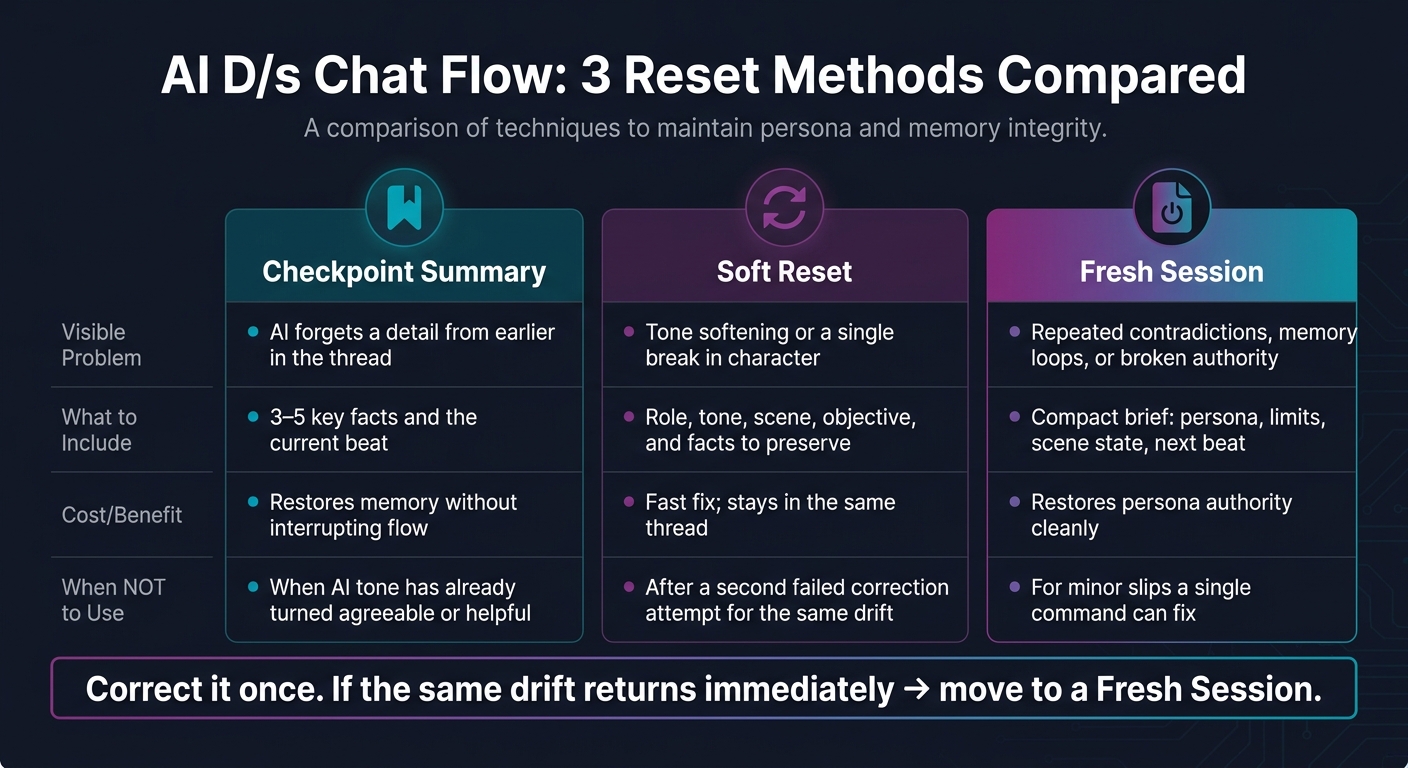
AI D/s Chat Flow: 3 Reset Methods Compared
Even a well-run session can start to wobble. Maybe the tone slips. Maybe the model starts repeating itself. Maybe it gives one response that just doesn’t fit. When that happens, you have two paths: fix the current thread or start over. Which one makes sense depends on how bad the break is.
Soft Reset Inside the Same Chat
A soft reset works best for small issues - a mild tone shift, one out-of-character reply, or a minor factual error. In that case, don’t write a long explanation. Send one short correction that restates the scene, tone, goal, and fixed facts.
Keep it tight. A long meta back-and-forth can eat up context and often makes the drift worse. In most cases, one dense paragraph does the job. Then end with the next action so the chat has a clear path forward.
If the same mistake shows up again, that reset didn’t stick.
Fresh-Session Reset for Repeated Contradictions
If the soft reset fails - or if the AI starts sounding apologetic or loses authority when it shouldn’t - opening a new session is usually the cleaner fix. Once the persona starts breaking down and your corrections stop holding, a fresh start is often the better move.
When you restart, bring over a short continuity brief in the first message. Include the character definition, hard limits, established facts, current scene state, and the next intended beat. That gives the model a clean context reset and helps the persona lock back in.
Choosing the Right Repair Method
The table below shows the three repair paths and when to use each.
| Option | Visible Problem | What to Include | Cost | When Not to Use |
|---|---|---|---|---|
| Checkpoint Summary | AI forgets a detail from earlier in the thread | 3–5 key facts and the current beat | Restores memory without interrupting flow | When the AI's tone has already turned agreeable or "helpful" |
| Soft Reset | Tone softening or a single break in character | Role, tone, scene, objective, and facts to preserve | Fast fix; stays in the same thread | After a second failed correction attempt for the same drift |
| Fresh Session | Repeated contradictions, memory loops, or broken authority | Compact brief: persona, limits, scene state, next beat | Restores persona authority cleanly | For minor slips a single command can fix |
Correct it once. If the same drift comes back right away, move to a fresh session.
When repairs stop working, the session usually needs better structure.
How to Structure Longer Sessions So They Stay on Track
When resets stop working, don’t keep patching the same thread. Change the setup. Prevention beats repair here: the less context the model has to juggle, the less likely it is to drift.
Break the Scene Into Phases Instead of One Long Thread
Split the scene into phases - baseline, limits, directives, enforcement, sustain - instead of running everything through one long thread. That way, each turn only carries what the next phase needs, not the whole history. When you move from one phase to the next, that’s the right time to refresh only what still matters.
There’s also a pacing benefit. Slow escalation tends to hold authority longer than jumping straight to maximum intensity. If you rush to the peak too early, the scene can lose shape fast.
Use Short Checkpoints and Selective Reinforcement
Phase shifts work best when you leave yourself a small handoff. At each transition, save a short summary - no more than one brief paragraph - that covers the key facts, emotional beats, standing rules, and the current scene state. Then, when the next phase starts, bring forward only that summary and the active limits. A "Story So Far" phase handoff at each phase shift can help prevent continuity drift.
The key is restraint. Reinforce only the rules and details that matter for the next phase, including unfinished tasks or current positions. Don’t restate the full setup from the beginning every time. Just carry forward the active facts, the limits still in play, and the next beat.
Conclusion: Key Habits That Protect Flow
Long chats stay steadier when the structure itself reduces drift, repetition, tone loss, and memory gaps. The habits that help most are compact role anchors, scene-state tracking, soft resets for small slips, fresh-session resets for repeated contradictions, and phase-based structure that cuts down how much continuity the model has to hold at once.
None of this is complicated. It just takes a deliberate hand: give the model the right amount of context at the right time, and stop making it carry more than it needs.
FAQs
Why do long AI D/s chats usually break after 10–15 exchanges?
Long AI D/s chats often fall apart after 10–15 exchanges because many systems lose continuity. At first, the tone may feel on point. But as the conversation keeps going, the model can drift into a more helpful, agreeable mode, and the main persona starts to fade.
The same thing happens with rules and limits. In longer chats, earlier instructions can slip out of context. And without persistent memory, small but important details - like pet names, prior commands, and punishment history - can vanish. Once that happens, the scene can lose its coherence and momentum fast.
What should I put in a good role anchor or state block?
Start with the role in one line, then state hard limits first, soft limits second, and say whether soft limits need a check-in before crossing them; after that, add tone and voice, identity continuity cues that keep names, pronouns, mood, and relationship framing steady, the intended scene progression in plain sequence, a reset or stop rule such as “stop,” “reset,” or “out of scene” ending or rewinding the exchange at once, and finish with the first command that tells the partner exactly how to begin. Keep everything in one tight paragraph so the setup survives long chats better, with no reliance on memory or scattered notes.
When should I reset the chat instead of correcting it?
Reset the chat only if the AI keeps drifting or can’t hold its persona even after you’ve corrected it.
Start with a short, direct redirect like “Stay Mistress” or “Shorter.” That often does the job.
If it still slips out of character or falls back into generic, supportive, or soft replies, resetting the session or switching characters is usually the best move.