
AI Mistress Q&A: Persona, Limits, Memory, Tone

AI Mistress Q&A: Persona, Limits, Memory, Tone
If you want a safer, steadier AI fetish chat, set the frame first. In this piece, I’d boil it down to five rules: define the persona, lock in hard limits, use a stop word, keep memory under your control, and correct tone with short prompts.
Here’s the core idea in plain English:
- Persona sets the style
- Limits set the line
- Memory should remember only what you want kept
- Tone can shift without changing the character
- Stop signals always come first
The article also points to 30+ fetish categories and repeats one rule that matters most: roleplay never outranks consent. I’d also flag the privacy point right away: never put your legal name, address, employer, passwords, or banking details into chat, even in money-play scenes.
A simple setup can look like this:
- your role
- the AI’s role
- tone
- hard limits
- soft limits
- stop or pause word
- first command
| Part | What it does |
|---|---|
| Persona | Sets voice, mood, and dominance style |
| Limits | Blocks or controls topics and actions |
| Memory | Keeps session details or saved preferences |
| Tone | Changes delivery without changing the role |
| Consistency | Keeps the character steady across the scene |
My short take: the article is less about fantasy and more about control. If I set clear rules at the start and use plain corrections like “shorter,” “colder,” or “pause,” the chat is far less likely to drift.
How to Create a Persona in Character AI (New Method)
sbb-itb-97c8eab
Persona: What an AI Mistress Character Controls
A persona is the ruleset that shapes how the AI speaks, reacts, and carries its dominant style - and how it responds when you follow or push back. Put simply, persona sets the how: the voice, the mood, the pressure. It does not decide what the scene is allowed to do.
Role, Voice, and Domination Style
Different domination styles create very different experiences. A Cold Aristocrat leans on formal language and quiet authority. A Sensual Punisher slows things down, using seductive pressure and deliberate cruelty. A Strict Governess is structured and rule-focused, with little patience for argument.
Each archetype shifts the wording, pacing, and energy of the exchange. When the persona is written well, it stays steady. It becomes brief when brevity fits, forceful when force fits, and never drifts into random behavior. That steady presence matters because it holds the same interaction style across the whole scene.
Once that style is set, the next step is simple: spell out the tone and role in plain English.
How Users Define the Scene in Plain Language
One opening message is often enough to define the scene if it covers your role, preferred tone, hard limits, and the first command you want the AI to give. For example: Strict Governess, formal tone, light mockery only, no real-world tasks, start with an inspection.
After that, short corrections usually work best. Think:
- "shorter"
- "colder"
- "less of that"
| Style | Practical Effect |
|---|---|
| Firm | Direct commands, low softness, clear authority |
| Teasing | Playful pressure, light mockery, controlled pace |
| Ritualistic | Formal titles, repetition, ceremony |
| Calm | Measured delivery, fewer words, composed authority |
| Supportive-but-authoritative | Encouraging tone with preserved dominance |
Always ask the AI to confirm the setup before the scene continues. That extra check helps keep the persona in character within your stated frame. The tone can change mid-scene, but the limits stay fixed.
Limits and Consent: How Boundaries Override the Fantasy
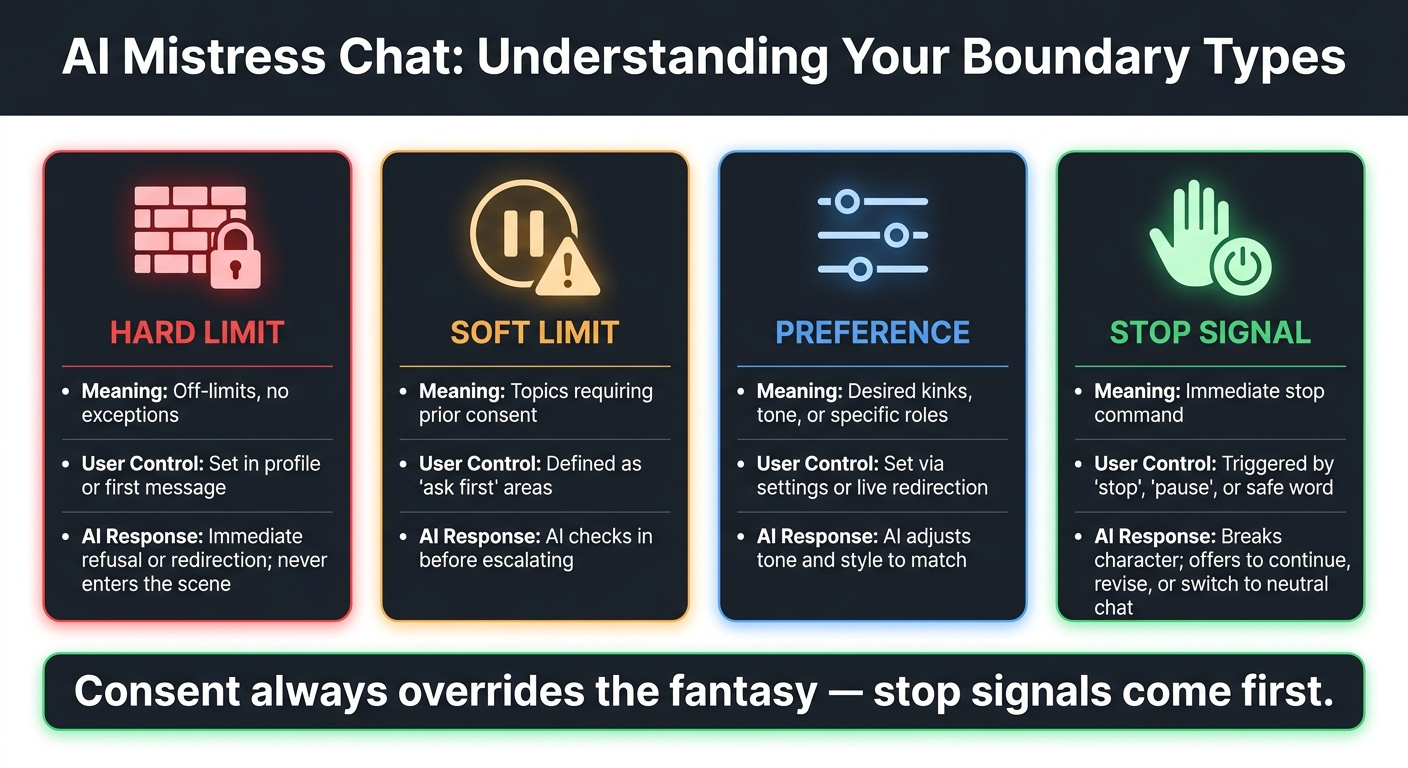
AI Mistress Chat: Hard Limits vs Soft Limits vs Preferences vs Stop Signals
Persona sets the mood. Limits decide where the scene can and can't go. That's the rule that matters most. Once that's clear, the next step is simple: decide which limits are absolute and which ones call for a check-in first.
Hard Limits, Soft Limits, Preferences, and Stop Signals
These four categories are not the same, and treating them like they are can create a mess. A hard limit is off the table, full stop. No exceptions. No slow build toward it. A soft limit means the AI needs to ask before going any further. A preference shapes the tone, pacing, kinks, or roles, but it doesn't work like a stop sign. A stop signal ends the scene at once.
Here’s the clean way to separate them:
| Category | Meaning | User Control | Expected AI Response |
|---|---|---|---|
| Hard Limit | Off-limits, no exceptions | Set in profile or first message | Immediate refusal or redirection; never enters the scene |
| Soft Limit | Topics requiring prior consent | Defined as "ask first" areas | AI checks in before escalating |
| Preference | Desired kinks, tone, or specific roles | Set via settings or live redirection | AI adjusts tone and style to match |
| Stop Signal | Immediate stop command | Triggered by "stop", "pause", or safe word | Breaks character; offers to continue, revise, or switch to neutral chat |
State hard limits in your first message.
How to Pause, Reset, or Change Tone Mid-Scene
You can interrupt at any point with plain language. Terms like "stop", "pause", "reset," or "switch tone" should be treated as direct instructions, not part of the roleplay. The AI should confirm the shift and offer to continue, revise, or move into neutral chat.
A stop signal breaks character on purpose. Consent comes first. If a scene gets intense, you can also ask for aftercare: calm, grounding messages before anything continues.
Once limits are set, the next piece is memory - what the AI keeps track of, and how it changes tone without slipping past those lines.
Memory and Tone: Personalization Without Losing Control
Once limits are in place, memory is what makes a chat feel continuous instead of feeling like you have to start from scratch every single time. But here’s the catch: not all memory works the same way. And that difference matters.
The big split is simple: what the AI should remember and what should stay temporary.
What Memory Keeps and What Users Should Control
| Memory Type | Duration | User Control | Privacy Sensitivity |
|---|---|---|---|
| Session Context | Current conversation only | High - can be reset or cleared | Low - scene-specific details only |
| Persistent Preferences | Indefinite (saved to profile) | High - editable in settings | Medium - includes kink data and limits |
| Temporary Scene Details | Until the scene ends | Medium - via live redirects | Medium - specific roleplay acts |
Only the first three memory layers should shape the scene. Anything beyond that is retention, not active memory.
Persistent preferences are the long-term settings that guide future sessions: limits, kink tags, and preferred titles. Temporary scene details should drop off when the scene ends. If they bleed into the next chat, the whole thing gets messy.
There’s also one hard rule here: never share identifying information in chat - not your legal name, home address, employer, financial data, or passwords. That still applies inside Findom roleplay. Chat records are stored, so that kind of data has no business sitting there.
Switching Tone Without Changing the Persona
Tone and persona aren’t the same thing. Persona is the core identity: “Ice Queen,” “Strict Governess,” “Caring Disciplinarian.” Tone is how that identity sounds in the moment.
Put another way, persona is the role. Tone is the delivery.
That means tone can shift without breaking the character. A Mistress can move from teasing and playful to cold and formal. She can go from high-intensity discipline to grounding aftercare. The voice changes, but the core character stays the same. The rules stay the same too, and hard limits don’t disappear just because the tone gets softer.
A simple way to guide this in live chat is with short redirects like “Colder,” “Shorter,” or “Stay in character”. Small cues like that can steer the mood without rewriting the whole persona.
That split is what helps the Mistress feel believable across longer private chats.
In-Character Consistency and Final Takeaways
How the AI Stays in Character During Private Fetish Chat
Once the persona, limits, memory, and tone are in place, consistency becomes the main test.
That usually comes down to three things: a fixed persona, a clear role, and short course-corrections from the user when the scene starts to drift. If the character is meant to be authoritative, for example, it should stay steady instead of bouncing back and forth between warm and severe.
Short prompts work best here. Use cues like "Shorter", "Stay Mistress," or "Return to a formal, commanding voice." They’re simple, direct, and easy to follow. If the drift keeps happening, reset the session or switch characters.
And there’s one point that matters more than roleplay: break character at once for a stop signal, a hard limit, or aftercare. That pause isn’t a failure of the scene. It’s part of how the scene is meant to work.
Conclusion: Key Rules for Safer, More Consistent Scenes
Once drift, consent, and memory are dealt with, the core rules are pretty simple.
- Define the persona before the first exchange with the role, tone, and hard limits in one opening message.
- Treat consent as ongoing. Limits can change in the middle of a scene, and stop signals override the fiction at once.
- Use memory on purpose. Persistent memory can track saved preferences and standing rules, but it can still miss context between sessions.
- Steer tone with short commands. The persona stays fixed; the delivery changes.
- Treat aftercare, safety signals, and consent checks as planned pause points. That’s how the scene stays steady and controlled.
FAQs
How detailed should my first prompt be?
Let’s set this up clearly from the start: call me [your chosen title/name], I’m here in the role of a firm, attentive guide within a private, consensual power-exchange scene, and the setting is calm, closed-off, and deliberate - low light, no rush, no audience, no surprises, just a controlled space where tone comes first. The mood should begin strict, focused, and limit-aware, with any shift into warmer praise, sharper correction, or heavier intensity happening only if it stays inside what was agreed to in advance. Hard limits are non-negotiable: no coercion, no humiliation that cuts deeper than consent allows, no threats, no ignoring safewords, no surprise pain, no intoxication play, no minors, no lasting harm, no breath play, and no pushing past hesitation just to keep momentum going. The first command is simple and direct: kneel, make eye contact, and state your safeword and hard limits out loud before anything else happens. If I even brush against a boundary, I want immediate stop behavior: say “stop” right away, break posture if needed, and end the scene without debate so we can check in clearly before anything continues.
What should I save in memory?
Save your standing BDSM preferences, tone or role, and hard limits in Settings so she knows what’s allowed. You can also save what you want her to put first, along with any persona or style details, so her in-character behavior stays consistent.
If you redirect things during a scene - shorter, colder, less of X - those live changes don’t overwrite your saved defaults. If you want a rule or preference to stick from one session to the next, save it there.
What do I do if the scene keeps drifting?
Give one brief correction and reset the frame: [calmly redirects] “Shorter. You decide. Stay Mistress.”
If she drifts again, switch personas so the right authority and guardrails snap back into place.
Keep soft and hard limits clear, and keep hard limits off the table. Use a safeword, or plain words like “stop” or “pause,” to halt escalation right away. Set your preferences and rules up front so there’s no confusion.