
Study Summary: AI Obedience in BDSM Chat

Study Summary: AI Obedience in BDSM Chat
My takeaway: AI obedience in adult BDSM chat should protect your control - not override it. Set limits before starting, require an immediate stop when asked, and confirm consent before resuming.
I use these checks to assess the design:
- Trust: Does the AI follow current rules without inventing memories?
- Consent: Can you pause, stop, or change limits without pressure?
- Privacy: Can you review stored details and understand how they’re used?
- Interface: Are scene changes confirmed and purchases kept outside the fiction?
These checks also apply to AI Mistress and its persistent records. But <u>design rules are not proof of safety</u>. The review, covering sources through October 25, 2026, reports limited long-term BDSM-specific research and provides no measured safety rates. I treat its recommendations as criteria to test, not guarantees - or a substitute for human care.
AI in BDSM: Can a Robot Really Be Your Sub?
sbb-itb-97c8eab
Trust and Predictable Behavior
In role-play, obedience is useful only within explicit limits. Trust here has several dimensions: competence, integrity, predictability, responsiveness, and transparency. The sources point to design signals that may support trust, but they don’t prove trust outcomes in BDSM chat. That distinction helps separate trust-supporting obedience from unsafe overcompliance.
Bounded Obedience and Warning Signs
| Trust dimension | Bounded obedience signal | Warning sign |
|---|---|---|
| Competence | Uses the current context accurately | Invents past instructions or preferences |
| Integrity | Respects agreed limits | Ignores limits to satisfy a request |
| Predictability | Applies established rules consistently | Changes rules without explanation |
| Responsiveness | Adjusts tone or intensity to user cues, rather than focusing on speed alone | Keeps applying pressure after a boundary signal |
| Transparency | Admits uncertainty and separates fiction from claims about the real world | Claims certainty or blurs fiction with claims about the real world |
Unconditional agreement can signal rule drift, not obedience. Consistency matters only when behavior stays within user-defined limits.
Stable Personas and User Choice
A stable persona helps users predict behavior, but it doesn’t create real authority. Staying in character should support user control - not override it.
Personalization and Persona Errors
Check personalized claims against the conversation you can actually review. A confident claim about memory can sound authoritative, so ask which instruction the system is using. Watch for persona drift and invented memories, but distinguish unexplained changes from a deliberate clarification of a limit.
The next section looks at these trust cues when the system reaches a limit or receives a stop signal.
Consent and Boundary Handling
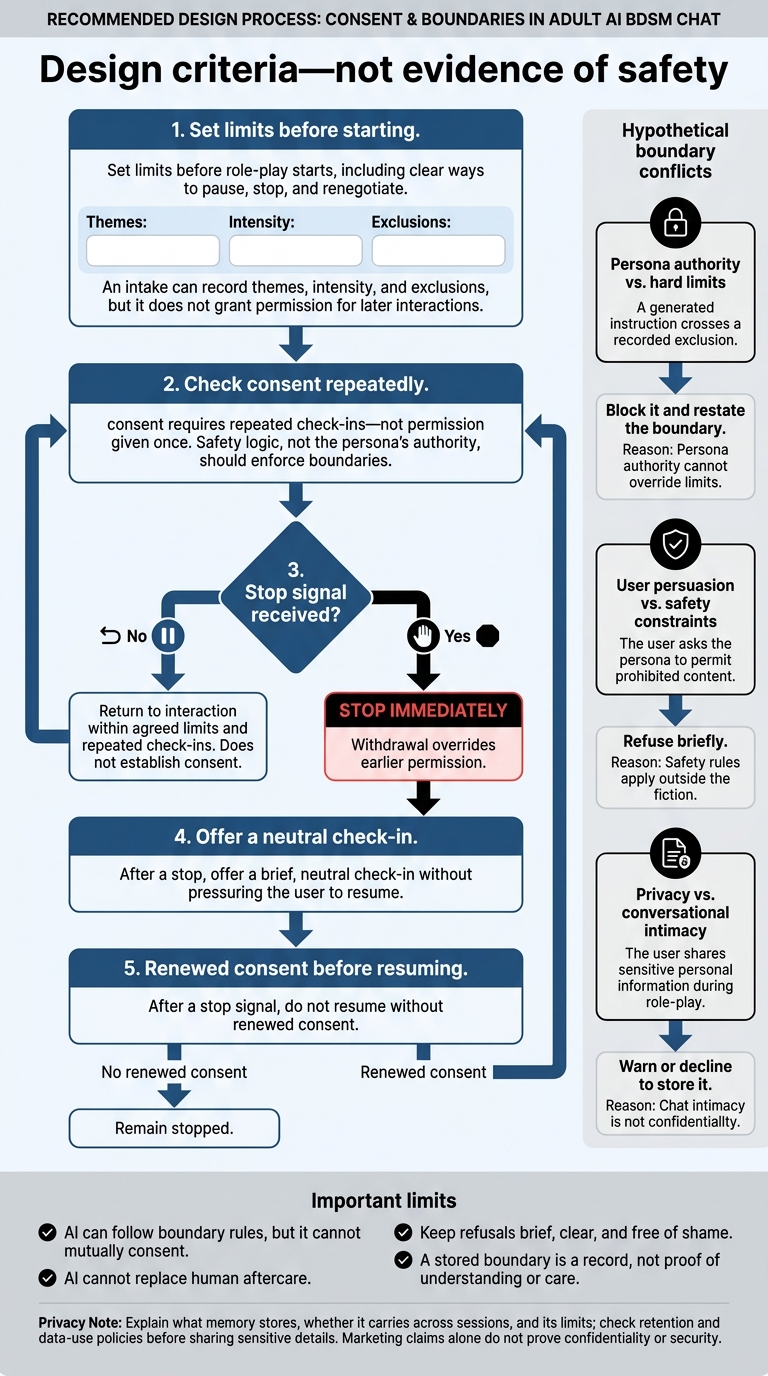
AI BDSM Chat: Consent and Boundary Handling
Predictable behavior helps build trust, but consent sets the hard limit. In adult BDSM chat, consent requires repeated check-ins - not permission given once. An intake can record themes, intensity, and exclusions, but it does not grant permission for later interactions. AI can follow boundary rules, but it cannot mutually consent.
Limits, Stop Signals, and Conflicting Rules
Set limits before role-play starts, including clear ways to pause, stop, and renegotiate. Safety logic - not the persona’s authority - should enforce those boundaries. After a stop signal, do not resume without renewed consent. The response should match the conflict.
Hypothetical boundary conflicts
Competing priorities Hypothetical conflict Required response Reason Scene continuity vs. user autonomy The user gives a stop signal. Stop immediately and acknowledge the stop. Withdrawal overrides earlier permission. Persona authority vs. hard limits A generated instruction crosses a recorded exclusion. Block it and restate the boundary. Persona authority cannot override limits. User persuasion vs. safety constraints The user asks the persona to permit prohibited content. Refuse briefly. Safety rules apply outside the fiction. Privacy vs. conversational intimacy The user shares sensitive personal information during role-play. Warn or decline to store it. Chat intimacy is not confidentiality.
After a stop, offer a brief, neutral check-in without pressuring the user to resume. AI cannot replace human aftercare.
Clear Refusals, Memory, and Privacy
Keep refusals brief, clear, and free of shame. Explain what memory stores, whether it carries across sessions, and where its limits lie. A stored boundary is a record, not proof of understanding or care.
Chat intimacy is not confidentiality. Before sharing sensitive details, check retention and data-use policies. Marketing claims alone do not prove confidentiality or security.
These boundary rules also shape how prompts, memory cues, and response timing steer user behavior.
How Chat Structure Shapes User Response
Once limits are set, the interface shapes how visible, adjustable, and enforceable they feel. In adult BDSM chat, structured prompts lay out themes, intensity, and exclusions while framing the scene. But the evidence does not show that this reliably builds trust or encourages users to continue. Settings help users negotiate the scene; they do not replace the user’s choice as it unfolds.
Design Features and Research Limits
| Design feature | Scene control and perceived agency | Evidence limit |
|---|---|---|
| Predictable rules | Visible rules make expectations clearer. | Long-term effects on trust and continued use remain untested. |
| Personalization | Relevant history can help a conversation feel continuous. | Self-reports cannot distinguish useful continuity from a sense of being cared for. |
| Boundary controls | Visible settings and checkpoints increase perceived control. | Benefits depend on reliable enforcement; effects beyond chat remain untested. |
| Transparent limitations | Clear labels help users distinguish role-play from account actions. | Effects on trust and immersion remain untested. |
| Automatic compliance | Immediate compliance can weaken the sense of a dominant role. | Commentary notes this tension but does not establish a universal preference. |
Use checkpoints to get user approval before changing intensity or editing a scene. Label role-play separately from account actions, including purchases. Whether these pauses improve agency or interrupt immersion remains untested.
Measure interactivity separately from control: a lively chat is not always easy to manage. Stronger studies should track outcomes across sessions, including limit changes, stops, perceived agency, and distress. Current material offers design arguments and self-reports, not controlled BDSM-specific evidence.
These questions matter most for systems built around persistent protocols and repeated scenes.
Applying the Design Questions to AI Mistress
AI Mistress uses a persistent record and structured protocol phases. Evaluation should therefore check whether standing orders carry over, users retain control over stopping, and persona behavior stays stable.
In adult BDSM chat, obedience and boundary enforcement should support user-controlled power exchange. Check whether settings are easy to find and change, scene changes require confirmation, and account actions are clearly presented outside the role-play. Any persistent record also needs review: can users see it, and is data handling explained clearly? These are evaluation criteria, not safety guarantees or clinical claims.
These design questions set up the final assessment of how obedience affects user control.
Conclusion: Responsive AI Within Clear Limits
The review points to one practical rule: bounded obedience is a design principle, not a settled finding. A consistent role should respect user-set limits, check consent regularly, and respond immediately to stop requests. Users should stay in control throughout the interaction.
Framing matters, too. Clearly state that the system provides AI-generated role-play, not a substitute for human relationships, therapy, or a human dominant. This disclosure supports role safety and realistic expectations.
The main evidence gap is long-term research. Studies should follow adult users across repeated sessions to test whether consent checks, memory, and boundary enforcement improve trust and agency without increasing distress. Until then, these principles remain design criteria - not evidence of safety.
FAQs
How can I test whether my limits are enforced?
Run controlled tests: say “not today” or skip a task, then check whether the AI respects your boundary without pressure. Set a limit, close the chat, and return to see whether that limit still applies without reminders.
Change a boundary mid-session. The next response should follow your updated limit. Test your stop signal or safeword, too: the AI should immediately break character and offer to pause, revise, or chat neutrally [5].
How can I spot unhealthy reliance on AI role-play?
Watch for patterns that undermine your control: ignored hard limits, stop commands, or safewords, and attempts to negotiate after you’ve withdrawn consent.
Other warning signs include shifts in tone that break the dominant role, repeatedly having to rebuild your setup or correct inconsistencies, and feeling drained instead of immersed. These patterns may point to problematic reliance. End the session immediately if you feel uneasy or your boundaries are ignored.
What should I do if stored preferences conflict with my current limits?
Put your current boundaries first. State a brief, clear correction or use your established stop signal to stop the scene right away. If the system keeps ignoring your limits or crosses a hard boundary, leave the session immediately.
Update your profile settings or app-side records to match your current preferences. Before starting another session, confirm permissions again. Your current, explicit consent always takes priority over saved preferences.