
Study Summary: NLP Trends in Adult Chatbots

Study Summary: NLP Trends in Adult Chatbots
Adult chatbots got better at conversation faster than they got better at consent and privacy.
If I had to boil this study down to a few points, it would be this:
- LLM-based bots feel more natural than old scripted systems
- Memory changes everything because it can keep roles, limits, and past chats in place
- Privacy risk is high when sexual chats are stored for long periods
- Moderation still struggles to tell consensual BDSM roleplay from coercion
- Age checks and consent tracking remain weak spots in many systems
A few numbers stand out right away:
- ~30 million users used AI companions like Replika by 2026
- 60% of respondents in one report said they had used AI in their intimate lives
- A 2024 breach exposed about 1.9 million users’ emails and sexual prompts
- About 1 in 4 people across OECD countries report lacking human connection
What does that mean for you? If a chatbot remembers your preferences, it can make BDSM roleplay feel more consistent. But that same memory can also store very sensitive data. So the tradeoff is simple: better chat often means more privacy risk.
I also see a clear pattern in the research: these systems are strongest at fluent erotic conversation and weakest at mid-chat consent detection, boundary changes, and safe handling of stored sexual data.
Quick comparison
| System type | Main strength | Main problem | Best fit |
|---|---|---|---|
| Rule-based | Predictable replies | Breaks fast and forgets everything | Simple, short chats |
| Intent-based | More flexible than scripts | Filters can interrupt adult scenes | Limited guided roleplay |
| LLM-based | Long, fluid roleplay with memory | Harder to moderate and riskier for privacy | Adult companion chat and BDSM scenes |
So if I’m reading the evidence plainly, the big shift from 2024 to 2026 is not just better language. It’s the move from stateless chat to stateful adult companions that remember, react, and sometimes store far more than users may expect.
My Chatbot, My Confidant?” Protecting User Privacy in Generative AI Conversations
sbb-itb-97c8eab
How NLP Systems in Adult Chatbots Are Changing
Rule-Based vs. Intent-Based vs. LLM Chatbots: NLP Comparison for Adult Chat
From Scripts to Large Language Models
Early adult chatbots worked like branching scripts. They could handle expected prompts, but one off-script message was often enough to make the whole exchange fall apart. They were also stateless, which meant every session started from scratch. No memory of preferences, no record of boundaries, and no carryover from prior scenes.
Modern LLMs are much better at open-ended conversation and can hold context across longer exchanges. That changes more than just how the chat sounds. It also affects memory, consent, and scene continuity.
Some newer systems also use persona logic to set behavior rules. That can include how a dominant persona reacts to compliance or refusal during power-exchange scenes.
For people who care most about anonymity, AI Mistress uses a no chat history storage policy.
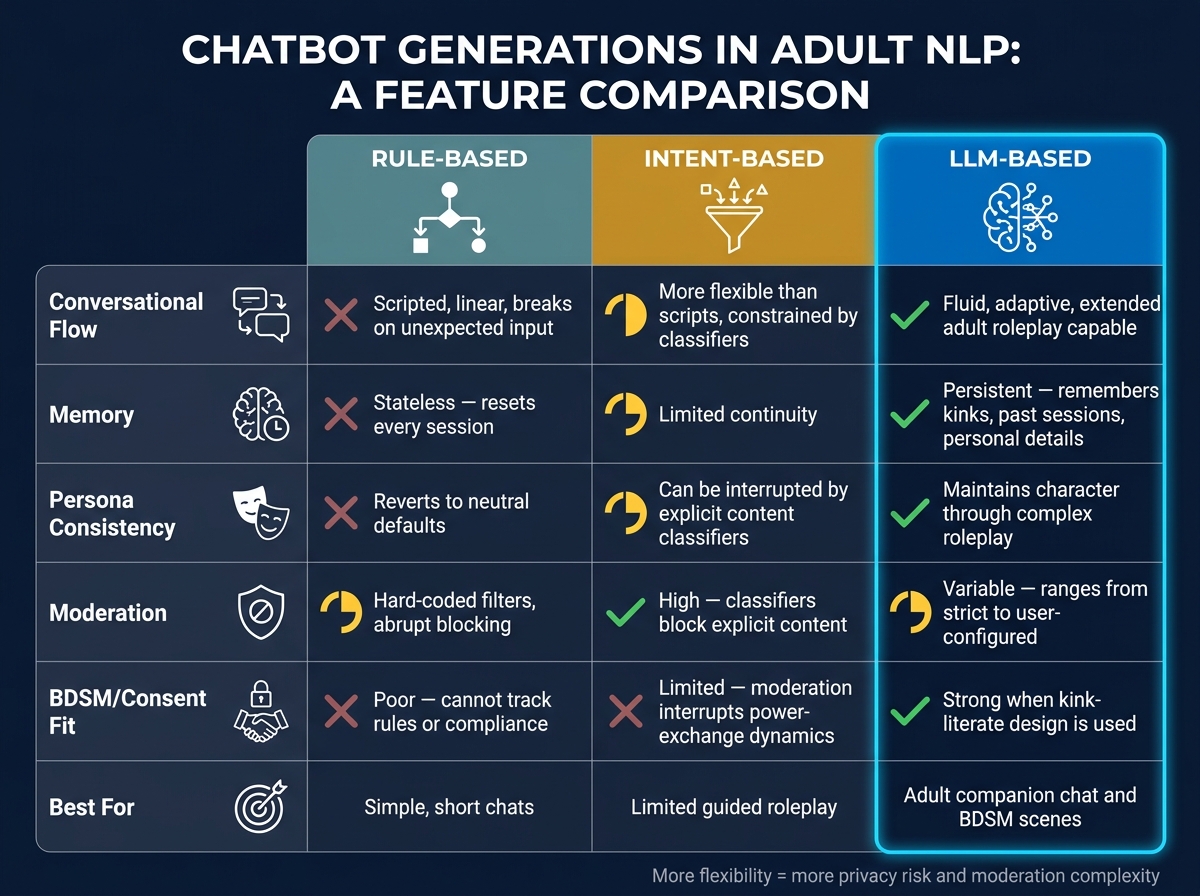
Comparison Table: Rule-Based vs. Intent-Based vs. LLM Chatbots
The table below shows the main trade-offs across chatbot generations. The basic pattern is straightforward: more flexibility can make the interaction feel more real, but it also puts more pressure on moderation and privacy.
| Feature | Rule-Based | Intent-Based | LLM-Based |
|---|---|---|---|
| Conversational flow | Scripted, linear, and easily broken by unexpected questions | More flexible than scripts, but still constrained by classifier-driven flows | Fluid, adaptive, and capable of extended adult role-play |
| Memory | Stateless; resets every session | Limited continuity | Persistent; can remember kinks, past sessions, and personal details |
| Persona consistency | Reverts to neutral defaults | Can be interrupted when content is classified as explicit | Maintains character even during challenges or complex role-play |
| Moderation | Hard-coded filters abruptly block explicit content | High; classifiers block explicit content | Variable; can range from strict to user-configured boundaries |
| Fit for consent-heavy BDSM scenes | Poor; cannot reliably track rules or compliance | Limited; moderation can interrupt power-exchange dynamics | Strong when kink-literate design is used |
Those trade-offs show up next in user habits, personalization, and privacy.
What Research Shows About User Habits, Personalization, and Privacy
User Habits in Intimate and Adult Chat
When an adult chatbot remembers past conversations, the interaction changes fast. Users stop treating it like a one-off script and start treating it more like an ongoing companion.
Research points to a clear reason for that shift: AI can work as a low-risk practice space where people explore desire, figure out the language of their own sexuality, and test limits without the fear of rejection or judgment that often comes with human vulnerability. That matters even more in a world where loneliness is common. Roughly 1 in 4 people across OECD countries report a lack of human connection, and some users turn to adult chatbots as a private outlet for desires they are not ready to share face-to-face.
A Lelo report adds one more data point: 60% of respondents said they had used AI in their intimate lives.
Personalization Benefits and Failure Risks
For users involved in power-exchange dynamics, memory isn't just a nice extra. It's part of the structure. It helps carry negotiated roles, safewords, and scene continuity across sessions, which is what makes BDSM roleplay feel coherent instead of random. Without that memory, users have to reset everything each time. And that's where stateless chatbots often fall apart - they feel flat, repetitive, and hard to stay immersed in.
That pressure pushes platforms toward longer memory and steadier persona logic. Some systems use numeric persona scores for traits like dominance or openness so the character stays consistent instead of slowly drifting into a generic, agreeable voice over time.
Still, there’s a catch. If the system reads the user wrong, the interaction can feel off, invasive, or both. And there’s also the risk of leaning on AI too much. As sex educator Sarah Tomchesson put it:
"The risk is that you rely on AI rather than developing your own skills and erotic imagination."
Privacy, Data Handling, and Consent-Aware NLP
The same memory that makes adult chat feel more immersive also piles up risk. More stored data can improve personalization. It can also make a breach far more damaging.
A clear example came in 2024, when a data breach at Muah AI exposed the email addresses and sexual chat prompts of about 1.9 million users. That case shows what’s at stake when intimate data isn’t handled with care. Retention policies also vary a lot. Some platforms keep data for up to six years after an account is closed. Others take a lighter approach. AI Mistress uses no-chat-history storage and web-based access, which cuts down app-store exposure and device tracking.
Consent-aware NLP focuses on boundary detection, withdrawal detection, and data minimization. In plain English, the system has to notice limits, notice when those limits change, and avoid keeping more sensitive data than it needs. That matters most when the AI is expected to track consent and boundaries in real time.
| Safeguard Function | How It Works | Why It Matters |
|---|---|---|
| Boundary Detection | Safeword recognition and frame-consent tracking | Keeps roleplay within negotiated limits |
| Consent Withdrawal | Detects explicit withdrawal or changes in user tone | Helps prevent the AI from continuing past a stated limit |
| Data Privacy | Encryption in transit and at rest; no-history storage | Protects sensitive disclosures from unauthorized access |
| Memory Management | Pinned memories and tiered context windows | Maintains immersion without storing raw chat logs indefinitely |
| Identity Protection | Web-based access with no app download required | Avoids app-store exposure and device tracking |
There’s another problem here too. Systems that gather all user data for personalization can also expose preferences to targeted advertising networks. When the data being mined comes from intimate conversations, that privacy risk hits a lot harder.
Moderation Patterns and Likely Shifts in BDSM Chat Use
Common Moderation Patterns in Sexual Content Handling
Once a chatbot stores preferences, moderation has to follow consent, not just spot keywords. Persistent memory makes chats feel more personal, but it also adds risk. And platforms make that tradeoff in very different ways.
Most systems fall into three groups: strict refusal, limited adult permission, and BDSM-aware moderation. Strict refusal blocks sexual content outright. Limited adult permission allows some adult content but sets firm boundaries around certain material. BDSM-aware moderation treats power dynamics as part of the persona, which helps keep the scene structure intact.
There’s also a separate issue: inconsistent enforcement. The same prompt may get one answer today and a different one after a wording tweak or model update. When erotic roleplay suddenly gets shut down, it can feel like the model was reset. In BDSM roleplay, that kind of unpredictability is especially disruptive. A policy change can break persona continuity and wipe out the flow of an ongoing scene.
False refusals and memory resets still show up often. If a system reads a power-exchange prompt as coercion, it may block a valid request. Or it may do the opposite and fail to catch something harmful. That’s the hard part: the surface language can look similar, while the meaning is completely different.
Comparison Table: Moderation Goals, NLP Signals, Failure Modes, and Responses
| Moderation Goal | Key NLP Signals | Common Failure Mode | Appropriate System Response |
|---|---|---|---|
| Age & eligibility check | Age cues in profile, language patterns, verification flags | Poorly enforced or missing verification | Mandatory age verification |
| Consent recognition | Safeword use, explicit agreement, frame-consent language | Forgotten after session reset or model update | Persistent storage of negotiated limits across sessions |
| Coercion detection | Non-consensual framing, pressure language, victim positioning | Misread as consensual roleplay due to surface-level similarity | Context-aware parsing that distinguishes power exchange from coercion |
| Self-harm or violence signals | Escalating distress language, requests for real-world harm | Missed when embedded in fictional framing | Hard refusal for real-world harm |
| Clear refusal language | Ambiguous or boundary-crossing requests | Vague deflection that leaves the user uncertain | Explicit, direct refusal without moralizing or character break |
These patterns suggest a broader move away from reactive filtering and toward stateful rule enforcement.
Likely Shifts in BDSM Chat Through 2026
The clearest shift is the move from stateless to stateful interaction. Newer platforms use persistent memory to carry negotiated rules, kink preferences, and prior consequences from one session to the next. That means users don’t have to rebuild the dynamic from scratch every time. AI Mistress, for example, offers nearly 30 distinct BDSM kink categories.
Hybrid moderation is gaining ground too. Instead of picking between blanket restriction and no restriction at all, some platforms are building systems that allow consensual adult roleplay while still issuing firm refusals for non-consensual, illegal, or minor-related content. That setup is harder to build, but it matches BDSM chat far better than all-or-nothing filtering.
At the same time, multimodal interaction is spreading. Voice synthesis, in-chat image generation, and AI-controlled media rewards tied to roleplay compliance are showing up more often. In plain terms, the AI gets more tools to shape the scene.
Conclusion: What the Evidence Supports and What Remains Unclear
Taken together, the evidence points to three clear findings. First, LLMs often default to being helpful and agreeable, and that can weaken dominant-role personas. Second, privacy exposure is well documented. Intimate data can stay at risk when platforms keep sensitive chat content without proper safeguards. Third, moderation systems still have trouble telling consensual power exchange apart from actual coercion, and leaning too much on AI for erotic exploration can carry real risks for a user's broader intimacy skills.
The long-term effects are still unclear. For 2026, three issues remain unresolved: mid-session consent detection still can't reliably tell roleplayed resistance from actual withdrawal; conflicting instructions between user intent and platform-level safety filters continue to create friction; and age assurance is uneven across the world, with verification standards varying a lot by region.
Those issues are still the main barriers to BDSM-aware NLP. Right now, NLP is at its best when it comes to fluent roleplay, and at its weakest when it comes to consent precision and long-term safety.
FAQs
How does chatbot memory affect consent?
Chatbot memory can support consent in power-exchange dynamics because it keeps track of a user’s kinks, limits, and preferences across sessions. That gives the AI a better chance of staying inside agreed boundaries and keeping the interaction structured and safe.
A no-history policy works in the opposite direction. It removes that memory on purpose to protect privacy, so each stateless session leaves no digital trace. The tradeoff is simple: users need to set boundaries again each time.
What data privacy risks should I watch for?
Many AI chatbots keep chat logs. They do this to personalize replies or support advertising.
That creates a plain privacy issue: anything you share may not be fully shielded. And if the platform has a security breach, exposed chat data can become part of the fallout.
Some services may store personal data for years, even after you close your account. Others may share that data with third-party analytics partners.
The safest move is simple: don’t share personally identifiable information in your chats. That includes things like your full name, home address, phone number, Social Security number, financial details, medical records, or account logins.
Why is BDSM moderation still unreliable?
BDSM moderation is still unreliable on many platforms because kink often gets treated like an afterthought, and the rules are usually vague. That creates a predictable mess: general-purpose AI may start moralizing, dodge the prompt, or suddenly break character right in the middle of an intense scene.
Longer sessions tend to make those weak spots more obvious. Memory lag can creep in, filtering can shift from one reply to the next, and the whole exchange can lose its thread. When that happens, power dynamics get disrupted, the AI loses focus, or it snaps back to restrictive safety protocols.