
AI BDSM Rituals: Daily Routines vs. Session Rules

AI BDSM Rituals: Daily Routines vs. Session Rules
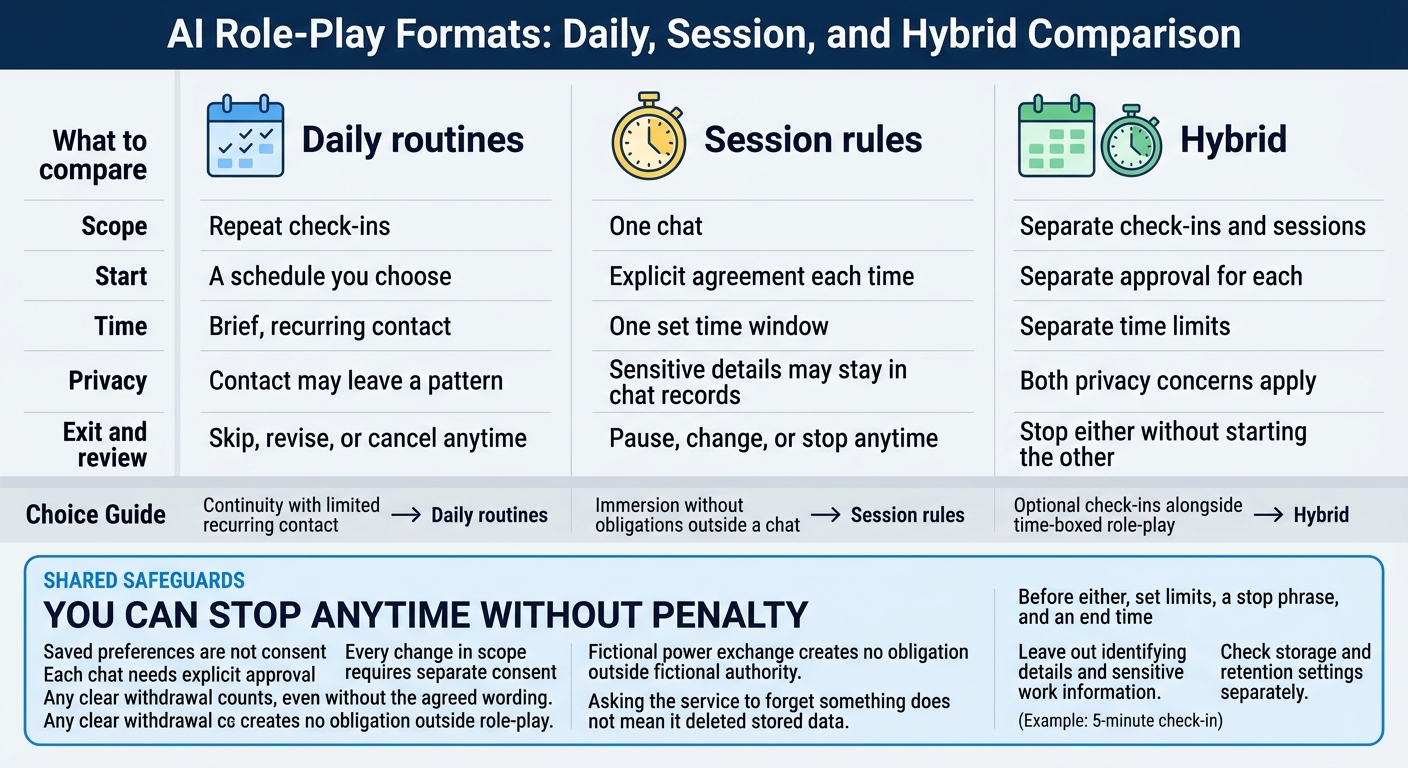
I’d choose daily routines for repeat check-ins and session rules for one time-boxed chat. Before either, set limits, a stop phrase, and an end time - for example, a 5-minute check-in. Both are voluntary adult role-play: <u>you can stop anytime without penalty</u>.
Quick Comparison
| What to compare | Daily routines | Session rules | Hybrid |
|---|---|---|---|
| Scope | Repeat check-ins | One chat | Separate check-ins and sessions |
| Start | A schedule you choose | Explicit agreement each time | Separate approval for each |
| Time | Brief, recurring contact | One set time window | Separate time limits |
| Privacy | Contact may leave a pattern | Sensitive details may stay in chat records | Both privacy concerns apply |
| Exit and review | Skip, revise, or cancel anytime | Pause, change, or stop anytime | Stop either without starting the other |
My rule of thumb: saved preferences are not consent, and fictional authority does not extend to work, health, or money. I’d confirm boundaries each chat, leave out identifying details, and check data-retention controls - asking an AI to forget is not the same as deleting stored data.
AI BDSM Rituals: Daily Routines vs. Session Rules
How to Create D/s Protocols That Work in Real Life
sbb-itb-97c8eab
Daily Routines: Check-Ins and Time Commitments
Daily routines help maintain continuity in power-exchange role-play. They don’t create duties outside the role-play. Stored details are references, not demands, and you can pause or stop at any time.
The main safeguard is a firm time cap.
Choose Check-In Times and Limits
Agree on how often to check in and how long each check-in will last before starting. Keep it brief - a greeting or status update - and stop when the time is up.
Skip or Cancel Without Penalty
Work, illness, travel, or a change of mind can put a routine on hold immediately. Missed check-ins never create make-up duties.
Daily Routines: Benefits and Limits
| Benefits | Limits |
|---|---|
| Continuity across conversations | Possible pressure to reply or keep up |
| Predictable, light structure | Scheduling conflicts and recurring time costs |
| Familiar openings and recurring details | Check-ins can turn into full sessions |
| Optional contact on your schedule | A rigid pace can make routines feel obligatory |
Repetition never makes participation mandatory. Slow the pace if the routine no longer feels freely chosen.
Session Rules: Clear Starts and Endings
Daily routines repeat, but session rules reset with each chat. They start with an explicit opening and end when the session closes or someone withdraws. Fictional restrictions stay inside the chat.
Agree on Language, Scope, and Duration
Before you begin, agree on the language, tone, forms of address, allowed fictional activities, off-limits content, and a firm end time. Choose an opening phrase to start the scene and a closing phrase to return to ordinary conversation. You don’t need permission to stop.
Pause or End a Session
Choose a pause word, stop phrase, or out-of-character break before the scene starts. A pause gives you room to clarify or change a boundary; a stop ends the session. Any clear withdrawal counts, even without the agreed wording. No session rule applies after that point.
If the AI misses a boundary or a change in tone, stop the chat. Each new chat begins with no prior session rules in place.
Compare Time and Consent Requirements
With the structure clear, consider how much time each format takes and what consent it requires.
Choose based on your availability, not a sense of obligation to the character. That might mean recurring check-ins or rules that apply to just one chat.
| Framework | Practical commitment |
|---|---|
| Daily routines | Optional recurring check-ins within an agreed reply window |
| Session rules | Focused attention during one agreed period |
| Hybrid | Optional check-ins plus separate sessions; neither starts the other |
With a hybrid format, you make two separate choices: whether to check in and whether to start a session.
Pair time limits with written boundaries and privacy choices so everyone knows what the agreement covers.
Write Down Boundaries and Privacy Choices
Leave out identifying details and sensitive work information. Before sharing personal material, review the service’s privacy policy and controls.
| Boundary | What to record |
|---|---|
| Start | The explicit agreement or prompt that starts the role-play |
| Scope | Included behaviors and hard limits, meaning excluded activities |
| Duration | Maximum length, ending time, and the condition that ends the scene |
| Availability | Whether later replies are optional |
| Privacy | Information not to share, plus privacy settings and controls to review |
| Exit | Safe words or phrases that immediately pause or end the scene |
| Review | Scheduled times to revisit limits or cancel the arrangement |
Asking the service to forget something does not mean it deleted stored data. Check storage and retention settings separately.
Written limits set the boundaries, but each new activity still requires its own consent.
Confirm Consent for Each Activity and Chat
Consent can change during a session or between sessions. Agreeing to one title, ritual, or fictional activity does not give permission for another.
Keep decisions about work, health, and money outside fictional authority. Saved preferences can guide future chats, but each chat needs explicit approval, and every change in scope requires separate consent.
Conclusion: Choose a Format That Fits Your Time
After weighing time and consent, choose the format that fits your schedule. Neither format is better than the other. Daily routines offer continuity but require recurring time. Session rules stand on their own and end with the chat. A hybrid works only if check-ins and role-play stay separate.
| Preference | Format to consider |
|---|---|
| Continuity with limited recurring contact | Daily routines |
| Immersion without obligations outside a chat | Session rules |
| Optional check-ins alongside time-boxed role-play | Hybrid |
Pick a pace you can comfortably step away from and return to. Fictional power exchange creates no obligation outside role-play.
FAQs
How can I tell if check-ins are becoming an obligation?
Pay attention to how check-ins feel and whether your routine leaves room for change. If they’re no longer fun, make you uncomfortable, or cross your boundaries, they may be turning into an obligation.
These simulated rituals should stay consensual and follow your preferences. If you feel pressured to perform, or the AI ignores your signals to pause or slow down, it’s time to rethink or reset your rules.
How do I keep a check-in from becoming a session?
Use a clear stop/reset protocol: type “Pause,” “Red,” “stop scene,” or your agreed stop word. Then switch to neutral, low-intensity language for aftercare or winding down. Don’t add rules or escalate. If you return to the scene, restate only the standing limits.
If memory is on, clear or update the scene rules before your next chat. After a brief grounding exercise or debrief, close the chat. Restart only when you explicitly choose to.
What should I do if the AI ignores my stop phrase?
If the AI ignores your stop phrase, end the interaction with a clear “Pause” or “stop scene” command. Tell it to drop the character and switch to a neutral or aftercare tone. If it still won’t comply, reset the persona and restate your limits and stop signals before continuing - or choose not to continue.
Your well-being comes first. Take a 10–30-minute break if needed, then update or clear the rules for your next chat.