
Forward Secrecy in AI BDSM Chat: 5 Key Facts
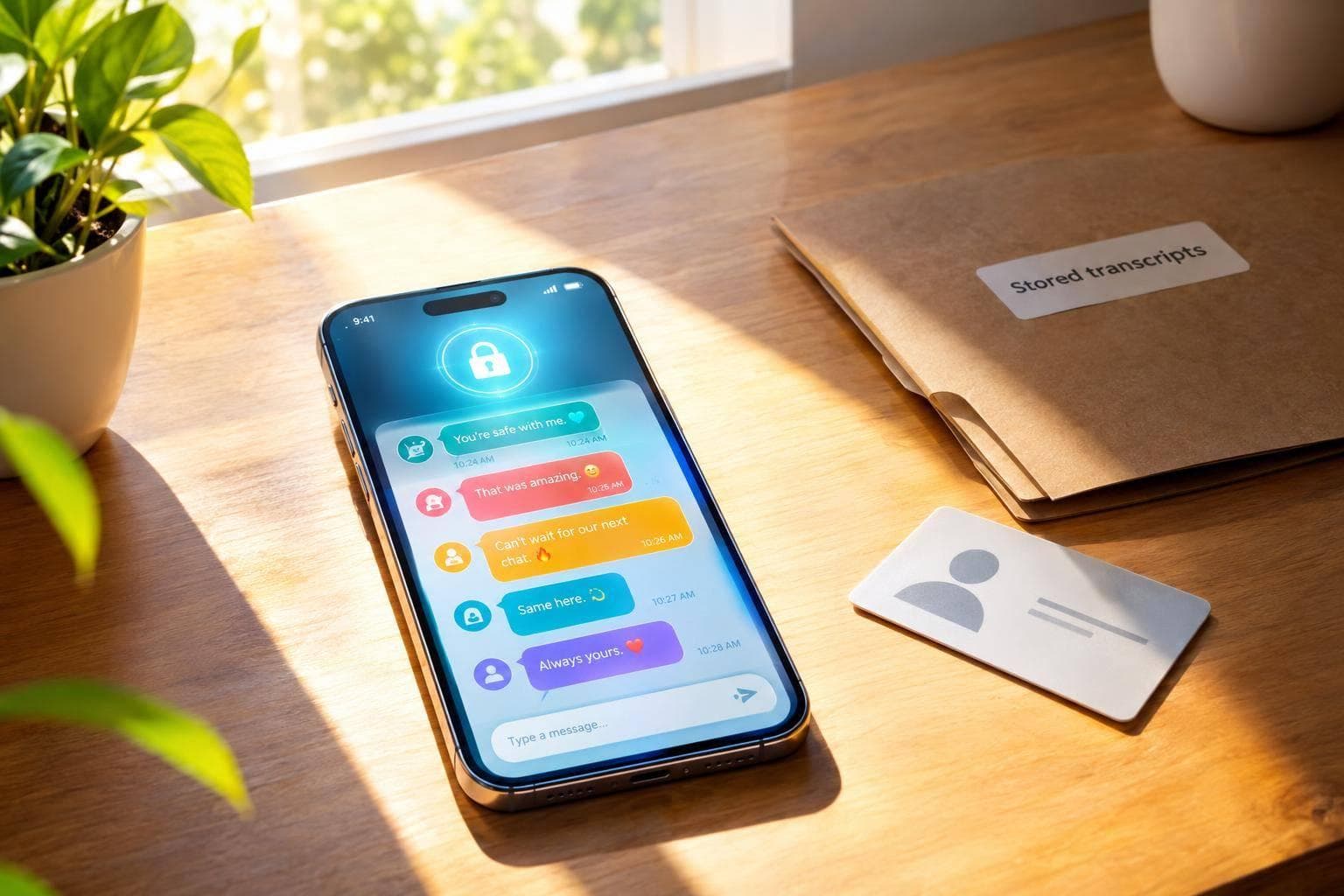
Forward Secrecy in AI BDSM Chat: 5 Key Facts
Forward secrecy can protect past intercepted AI chats after server-key theft - but it does not protect saved chats or hide your identity. I treat connection security and chat privacy as separate checks: before sharing sensitive details, I check how the service handles encryption, storage, and deletion.
Here are the 5 facts I keep in mind:
- Temporary keys protect past connections. That protection depends on proper key generation and disposal.
- TLS 1.3 has limits. Its handshake must support forward secrecy; 0-RTT early data does not have that protection and can be replayed.
- Diffie–Hellman creates a shared secret without sending it. The browser and server use it to derive encryption keys.
- Deleting temporary keys limits exposure. Keeping them in logs or backups can put recorded traffic at risk. Deleting keys does not delete transcripts.
- Forward secrecy does not provide anonymity. IP addresses, email, payments, and details you type can still link chats to you.
For services such as AI Mistress, <u>HTTPS alone is not proof of privacy</u>. I check retention and backup rules, use a separate email and MFA where available, and leave identifying details out of prompts.
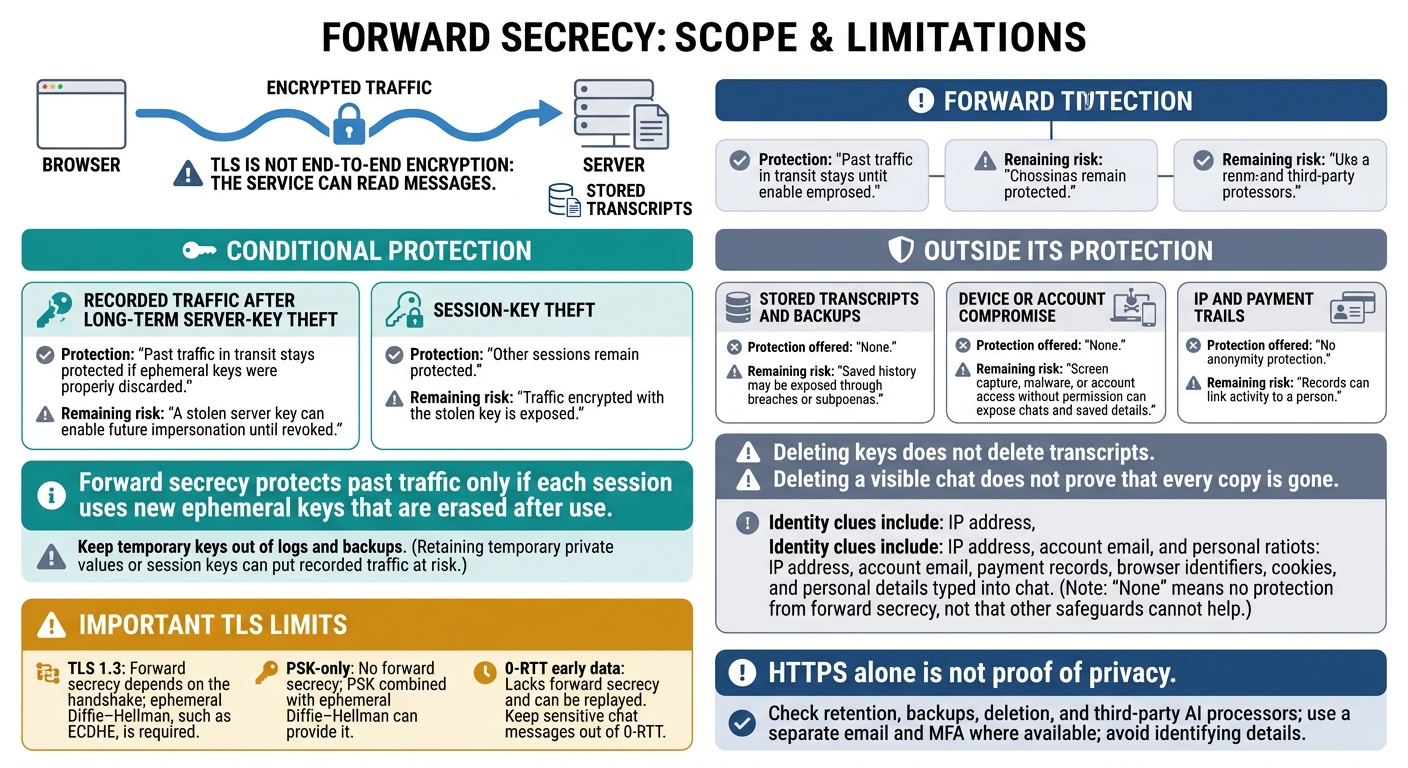
Forward Secrecy: What It Protects - and What It Doesn’t
TLS and Perfect Forward Secrecy Explained: Secure Data in Transit
sbb-itb-97c8eab
Connection Security vs. Stored Chat Privacy
Forward secrecy protects past chats in transit. Stored chats, backups, and memory need separate protection.
Long-term authentication keys verify the server, while session keys encrypt a single session. Temporary, or ephemeral, key-exchange values help establish session keys. TLS 1.3 uses this exchange process for connections that provide forward secrecy.
TLS protects messages as they travel. Once the server decrypts them, saved transcripts, memories, and backups need their own safeguards. Encryption at rest helps protect stored data, but it may not stop someone logged into your account from reading your history. Both key exchange and chat storage deserve attention.
Check the privacy policy to see what gets saved, how long it stays, and whether deletion covers backups and third-party AI processors. A no-history policy should spell out what it still keeps. Turn off history and delete transcripts where those options are available. Clearing memory may not delete the chat.
1. Temporary Keys Help Protect Past Connections
Temporary keys help keep old chats from being decrypted later. With forward secrecy, stealing a server’s long-term key should not let an attacker read past chats. Each connection uses temporary, or ephemeral, keys that are separate from the server’s long-term key.
That means recorded traffic should remain unreadable even if an attacker later steals the long-term key. When checking security claims, look for forward secrecy or temporary key exchange. This protection applies to traffic in transit, not saved chats.
The key exchange must be implemented correctly. Temporary secrets need to be unpredictable and erased after use. Otherwise, a later breach could expose those secrets and leave past connections at risk.
2. TLS 1.3 Supports Forward Secrecy, With Limits
TLS 1.3 uses temporary session keys, but forward secrecy depends on the handshake. It requires ephemeral Diffie–Hellman, such as ECDHE. PSK-only exchanges don't provide forward secrecy; PSK combined with ephemeral Diffie–Hellman can.
0-RTT early data makes reconnects faster, but it lacks forward secrecy and can be replayed. That remains true even if later traffic gets stronger protection. Keep sensitive chat messages out of 0-RTT.
TLS also doesn't make chat end-to-end encrypted. The service can still read, moderate, or store messages. Even with TLS 1.3, your identity and stored messages need separate privacy safeguards.
For AI Mistress Webchat, check the privacy and retention policies before sharing sensitive messages. Connection encryption doesn't protect stored chats.
3. Diffie–Hellman Creates a Secret Without Sending It
With ephemeral Diffie–Hellman, each side generates a temporary private value and a public value. The private values never leave their devices. Each side combines its own private value with the other side’s public value to calculate the same shared secret - without sending that secret across the network.
TLS then uses the shared secret to derive session encryption keys, which protect messages between the browser and server. Temporary secrets must be erased once they’re no longer needed. Doing so reduces exposure and helps protect past sessions if a long-term key is exposed later. That protection depends on deleting the temporary secrets after use.
4. Deleting Keys Limits Damage From Key Theft
Keep temporary keys out of logs and backups. These can retain temporary private values and session keys long after they should be erased. If someone recovers those keys later, they may be able to read recorded traffic. Key disposal matters just as much as key generation.
Once a shared secret exists, keeping it safe depends on what gets erased - and which key someone steals. A stolen long-term key should not expose past sessions protected by forward secrecy. A stolen session key exposes only its own session. But storing many session keys together puts more sessions at risk if that storage is compromised.
Key theft and transcript storage are separate risks. Deleting keys does not protect stored transcripts. For sensitive BDSM chats, delete chat history, remove saved sessions, and avoid identifying details.
5. Forward Secrecy Does Not Hide Your Identity
A secure connection can still leave clues about who you are. Forward secrecy protects past intercepted chat traffic, but it does not hide your identity.
Your IP address, account email, payment records, browser identifiers, and personal details typed into chat can still identify you. Cookies can link sessions, account records can link activity to an email address, and billing records can reveal the platform name.
Public pages give conflicting information about chat retention, so check the policy that applies to your account.
A VPN and privacy-focused browser settings can reduce tracking. But anonymity takes more than forward secrecy: these tools don't erase account links, payment records, or personal details you share in chat.
Forward Secrecy: Protection and Remaining Risks
Forward secrecy protects past traffic only if each session uses new ephemeral keys that are erased after use. It does not protect stored data or identity.
| Scenario | Protection Offered | Remaining Risk |
|---|---|---|
| Recorded traffic after long-term server-key theft | Past traffic in transit stays protected if ephemeral keys were properly discarded. | A stolen server key can enable future impersonation until revoked. |
| Session-key theft | Other sessions remain protected. | Traffic encrypted with the stolen key is exposed. |
| Stored transcripts and backups | None. | Saved history may be exposed through breaches or subpoenas. |
| Device or account compromise | None. | Screen capture, malware, or account access without permission can expose chats and saved details. |
| IP and payment trails | No anonymity protection. | Records can link activity to a person. |
Check whether transcripts, summaries, and backups are kept. Deleting a visible chat does not prove that every copy is gone.
Conclusion: Pair Forward Secrecy With Other Privacy Safeguards
Forward secrecy limits the damage if a long-term key is exposed later. But it doesn’t make AI chat end-to-end encrypted or anonymous.
Treat HTTPS as a starting point - not proof of privacy. Before using AI Mistress, read its current security, retention, and deletion policies. Check how it handles encryption, who can access your data, and what rules apply to removing it.
Then reduce your own exposure. Use a separate email address, a password you don’t use elsewhere, MFA if available, updated devices, and a strong screen lock. Keep names, employers, locations, and social media handles out of prompts, and review billing records before paying. These steps address privacy risks beyond the connection that forward secrecy protects.
FAQs
How can I verify a chat uses forward secrecy?
Look for explicit confirmation of forward secrecy, such as TLS 1.3 with ephemeral Diffie-Hellman key exchange. A claim of “SSL/TLS encryption” alone isn’t enough.
AI Mistress materials confirm encryption in transit (SSL) and EU hosting, but they don’t explicitly mention forward secrecy or ephemeral key exchange. That information alone doesn’t confirm forward secrecy.
Can I disable 0-RTT for sensitive chats?
The available sources don’t say whether you can disable 0-RTT for sensitive chats. AI Mistress mentions SSL/TLS encryption and makes privacy claims, including that it doesn’t store chat history. But it doesn’t explain its 0-RTT settings.
To check whether you can control 0-RTT, you’d need the site’s documentation or details about your browser’s or client’s TLS configuration. The sources don’t include that information.
How can I confirm my chat backups were deleted?
Check the privacy policy and legal pages on the AI Mistress website to confirm what it says about handling your data. AI Mistress states that it does not store chat histories on its servers, so there are no chat backups to manage or delete.