
Privacy in AI Domination: What You Need to Know

Privacy in AI Domination: What You Need to Know
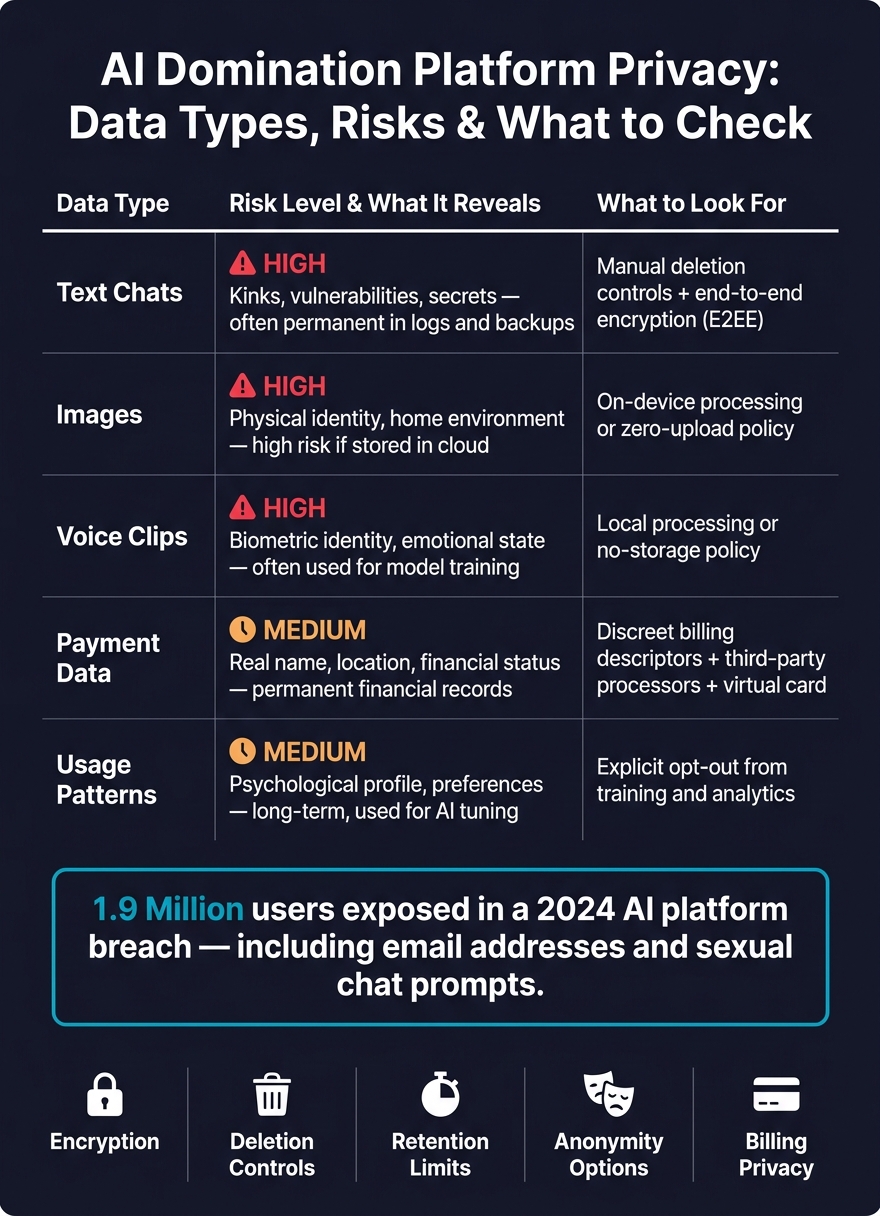
If I had to boil this down to one point, it’s this: the biggest privacy risk isn’t the chat itself - it’s what gets stored after the chat ends. In 2024, a breach tied to Muah AI exposed about 1.9 million users’ email addresses and sexual chat prompts. That’s the kind of fallout I’d keep in mind before sharing anything personal.
Here’s the short version:
- Check what the platform collects: email, IP address, device data, chat logs, photos, voice clips, and billing details
- Look for storage limits: how long data stays in live systems, logs, and backups
- Make sure deletion is clear: chats, files, and account data should be removable without vague wording
- Review training and consent settings: your chats may be used to improve AI models unless you opt out
- Protect your identity: use a separate email, a fake display name, and avoid face photos or voice uploads
- Protect your payments: use a prepaid or virtual card if you don’t want charges linked to your main bank account
- Lock down your account: strong password, MFA, and limited device permissions
What matters most is simple: share less, store less, and link less to your real identity. I’d judge any service on encryption, retention, deletion controls, staff access, anonymity options, and billing privacy before using it.
| Area | What I’d check first | Main risk |
|---|---|---|
| Chats | History off, deletion tools, training opt-out | Sexual prompts and personal details staying in logs |
| Media | No-upload option, no-storage policy | Face, voice, or home details tied back to you |
| Payments | Billing descriptor, card processor, auto-renew | Real name and purchase trail on statements |
| Account security | MFA, session control, clear account deletion | Account access and leftover stored data |
| Privacy policy | Backup deletion, third-party sharing, breach history | Data sitting in places you can’t see or control |
If I were reading this for one answer, it would be this: use only platforms that explain retention and deletion in plain English, and never share more than you’d be willing to see exposed later.
What data AI domination services may collect and where risks appear
Data collected at signup, in chats, and through media features
After the privacy basics, the next step is simple: look at what the service actually collects.
Before you even send a message, a platform may log your email, username, IP address, and device details. Age checks can happen through a checkbox, card verification, or a third-party ID service.
Once you're in, every conversation can turn into stored data. Some services pull details from chats - such as your name, age, relationship history, and limits - to build long-term memory. Some platforms also track typing patterns and hesitation time so the AI can tune replies to how you interact.
Media features bring the biggest privacy risk. Uploaded photos, voice clips, and AI-generated images may stay tied to your session history. And even if a platform uses a third-party processor for card payments, billing metadata can still connect your activity to your identity. Some services plainly say their name will show up on your bank statement.
How storage, retention, and internal access create risk
The big issue isn't just what gets collected. It's where that data sits, who can reach it, and how long it sticks around.
Chat logs, images, and behavior data can remain in live systems, backups, and internal logs. Retention windows are often vague or buried deep in the terms. That risk gets worse when backups and logs stay in place even after a user deletes a chat.
Staff and internal systems may still be able to view raw logs, which weakens privacy even if no public breach ever happens. Some platforms can't offer end-to-end encryption because their systems need to screen content for illegal material. Then there's AI training: many services keep the right to use your chats to improve their models, often without a clear opt-out.
Privacy impact by data type: comparison table
Not all data creates the same level of exposure. Some details are awkward if leaked. Others can tie directly back to who you are.
Use this table as a gut check before you share anything personal.
| Data Type | What It Can Reveal | How Long It May Persist | What to look for |
|---|---|---|---|
| Text Chats | Kinks, vulnerabilities, secrets | Often permanent in logs and backups | Manual deletion controls and E2EE |
| Images | Physical identity, home environment | High risk if stored in the cloud | On-device processing or a zero-upload policy |
| Voice Clips | Biometric identity, emotional state | Often used for model training | Local processing or a no-storage policy |
| Payment Data | Real name, location, financial status | Permanent financial records | Discreet billing descriptors and third-party processors |
| Usage Patterns | Psychological profile, preferences | Long-term, used for AI tuning | Explicit opt-out from training and analytics |
Next, check whether the service limits retention, encrypts content, and gives you control over deletion and account privacy.
sbb-itb-97c8eab
AI Privacy Risks: Five People Who Can Read Your Chats
What to check before using a service
AI Domination Platform Privacy: Data Types, Risks & What to Check
Before you create an account, look at the privacy controls the service actually gives you. Then measure those controls against the data risks above before you type in your name, email, or payment details.
Encryption, retention limits, and deletion controls
At the bare minimum, a service should encrypt your data in transit with SSL/TLS and at rest. That’s table stakes. Many services still skip E2EE because moderation depends on server-side access.
Encryption is only part of the story, though. You also want clear retention limits. Can you turn chat history off completely? Does the company say how long it keeps prompts, uploads, or logs? If the answers feel vague or hard to find, that’s a bad sign.
Consent settings, anonymity options, and account security tools
Next, check whether the service can use your conversations to improve or train its AI models. There should be a plain opt-out or consent setting. If there’s no clear opt-out, treat that as a warning sign.
It also helps to look at how much of your identity the service demands up front. Some platforms let you start with guest access or anonymous sessions instead of a real name or email verification. That keeps your identity out of the signup flow at the start.
For account security, make sure the platform supports:
- strong, unique passwords
- multi-factor authentication (MFA)
- active-session tracking
- clear account termination procedures
Red flags in privacy policies and settings
Some privacy-policy language should make you pause right away. If a service says it shares data with third parties or unnamed partners, stop and read much more closely.
A few warning signs stand out:
- No visible privacy settings menu after login
- No explanation of what happens to backups when you delete your account
- No clear process for deleting individual messages, files, or account data
- A documented breach history
- No clear synthetic-content compliance statement
These checks help you decide whether a service deserves any trust at all. If the policy is muddy, walk away and keep your profile and payment details to a minimum.
Safer habits for protecting your identity, boundaries, and payment data
After you review the platform’s controls, the next step is simple: share less yourself. A service can have solid settings, but your own habits still shape how much of your real identity reaches that company.
Share less identifying information from the start
Use a dedicated email address only for this account and a pseudonym instead of your real name. Don’t put your employer, home address, or social media handles in your profile or in chat messages.
The same idea applies to photos, audio, and other media. Avoid uploading face photos, government IDs, or voice samples that could identify you unless you’re okay with the risk of storage issues or a breach. Once that content lands on a server, your control over it gets pretty limited. Put plainly: the less identifying data you share now, the less can be exposed later.
Limit device permissions and account access
Say no to microphone, camera, photo library, contacts, and location access unless a feature needs them. If you’re using text-only sessions, you don’t need any of those permissions.
For account security, use a unique password from a password manager, turn on multi-factor authentication if the platform offers it, and delete old chat histories. That helps keep the app from holding more data than the conversation calls for.
Check your billing and payment exposure
Your billing descriptor - the name that shows up on your bank statement - can still tie your real identity to the service. Some companies put the product name directly in billing records. If that bothers you, a prepaid card or virtual card can help keep the charge off your main bank account.
It’s also smart to check whether you’re paying once or signing up for an auto-renewing subscription. Skip shared family or workplace billing accounts when privacy matters. Receipts and purchase records can reveal activity, and separating payment data from your main financial identity gives you a bit more distance.
What safer platform practices look like and key takeaways
Signs that a service takes sensitive content seriously
After checking your own settings, look at the platform itself. The main thing to judge is how it stores, limits, and protects sensitive data.
A privacy-focused service doesn’t just make claims on a landing page. It builds those choices into the product. That usually means privacy by design: less storage, tighter access, and clear deletion options. Minimal data collection matters for a simple reason. If chat history isn’t stored, there’s less that can be exposed. AI Mistress takes this approach, storing no chat histories and encrypting all data in transit.
Internal access matters too. Even without a public breach, stored data can still be seen by the wrong people inside a company. That’s why role-based, logged access to any stored data is a meaningful safeguard, not some nice extra.
Media handling is another big one. Platforms that limit or remove user image uploads cut down the risk of photo misuse. Text-only channels also lower exposure from images, voice, and file uploads. And when it comes to account privacy, no verified identity required is a real privacy control.
Use the table below to spot the platform practices that matter most.
| Practice | What to look for |
|---|---|
| Data retention | No-storage policy or user-controlled history toggle |
| Media handling | No user uploads or pre-moderated content only |
| Internal access | Role-based, logged access to any stored data |
Conclusion: the shortest path to better privacy
If a service fails these basics, it fails the privacy test.
AI domination data is high-risk because it is intimate. The bigger risk is losing control of sensitive content. Before sharing anything personal, verify encryption, retention limits, deletion controls, consent settings, anonymity options, and account security tools. Then pair that with the habits covered earlier - dedicated credentials, limited device permissions, and separated payment methods - and you’ve meaningfully reduced your exposure.
A transparent service shows who operates it, where data is hosted, and how deletion works.
FAQs
How can I tell if deleted chats are really gone?
Check whether the service lets you delete chat history or request permanent deletion. Then make sure it plainly says your stored content is removed and that you can turn chat history off right away.
For example, Mistrezz says you can delete your entire chat history in one click, request permanent data deletion at any time, and that chats are encrypted with restricted, logged access.
Is it ever safe to upload a face photo or voice clip?
Not completely.
When you upload a face photo or voice clip, you’re sharing biometric data and personal identifiers. That kind of data is sensitive, and it could be exposed if the service gets breached.
For the strongest privacy, don’t upload them.
If you decide to use a service anyway, look for these basics:
- Encryption
- Strict data retention policies
- Anonymity options
- Clear promises not to sell user data to third parties
That’s the bare minimum if privacy matters to you.
What’s the safest way to pay without linking my real identity?
To help protect your identity, use a prepaid card or cryptocurrency to keep your financial details separate from your personal identity.
Before you pay, make sure you're on the platform's official payment page. It's also smart to use a dedicated email address that's not tied to your main accounts. Then take a minute to review the privacy policy so you know how billing data is stored and processed.