
AI BDSM Memory Tools: Platform Comparison

AI BDSM Memory Tools: Platform Comparison
If an AI BDSM platform remembers too much, your privacy risk goes up. If it remembers too little, scene continuity breaks. That is the core tradeoff here.
I’d sum this article up like this: the five memory tools that matter most are profile tags, preference logs, chat summaries, scene history, and reset controls. Of those, tags and preference logs are usually the safest way to keep limits and roles steady, while chat summaries and scene history store more sexual context and carry more risk. AI Mistress leans toward lower retention, with settings-based memory but no server-side chat history, which cuts stored scene data but can reduce long-term continuity.
If you only check four things before using any platform, check these:
- Can you see what is stored?
- Can you edit it?
- Can you delete one item without wiping all data?
- Does chat deletion also remove summaries or memory?
This comparison covers all five memory layers and looks at them through the same lens:
- What gets stored
- How much control you get
- How resets work
- How consent and limits are handled
- What privacy risk comes with each layer
Bottom line: for BDSM roleplay, the safer setup is usually structured memory for limits and roles plus clear reset options, not deep storage of sexual chat logs.
Quick Comparison
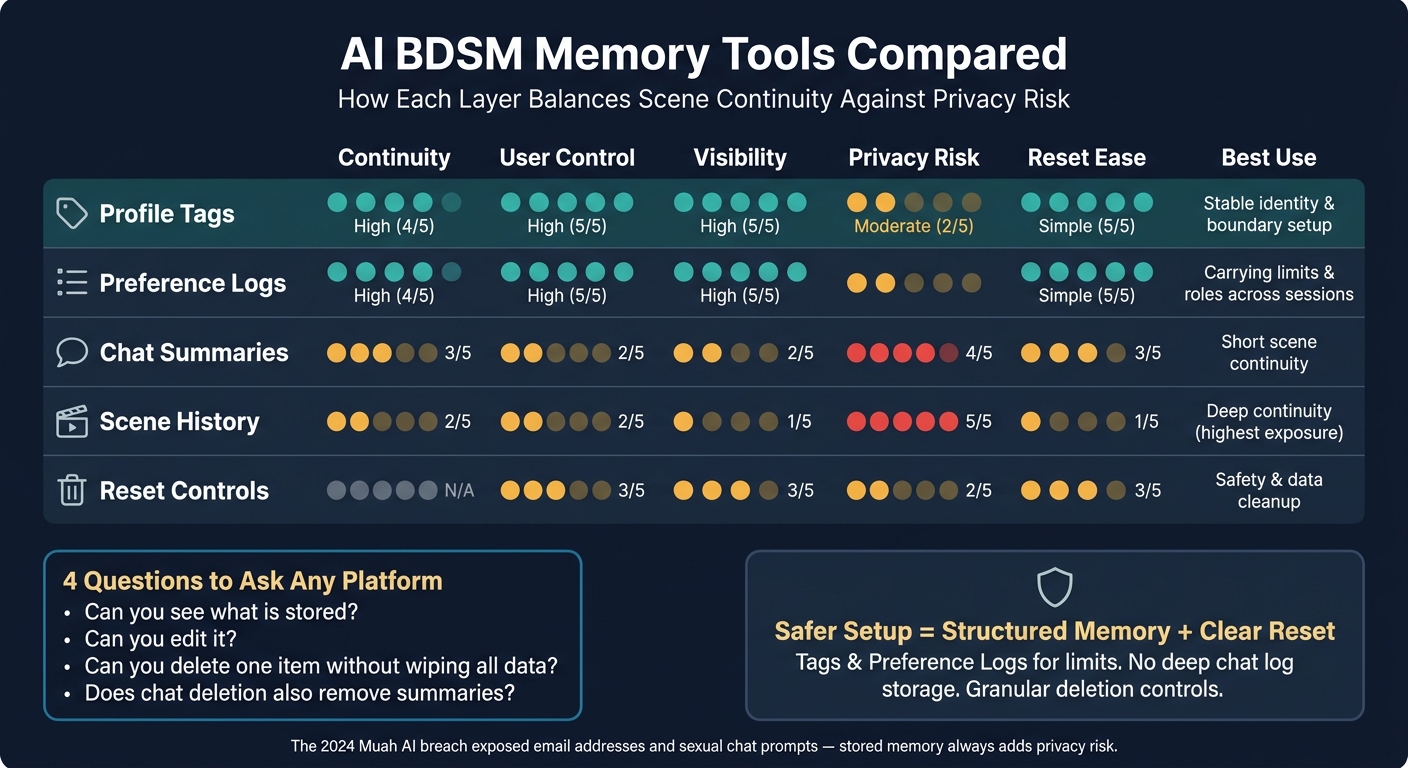
AI BDSM Memory Tools Compared: Privacy Risk vs. Continuity
| Tool | What it remembers | Best use | Main risk | User control |
|---|---|---|---|---|
| Profile Tags | Roles, kinks, hard/soft limits, intensity markers | Stable identity and boundary setup | Sensitive preference data stays attached to account | High |
| Preference Logs | Default settings and changes over time | Carrying limits and roles across sessions | Stores sexual preference data | High |
| Chat Summaries | What happened in prior chats | Short scene continuity | Missed details or wrong summaries | Medium to low |
| Scene History | Full or near-full record of scenes | Deep continuity | Highest exposure if leaked | Low to medium |
| Reset Controls | Not memory itself, but deletion tools | Safety and cleanup | Weak controls can leave data behind | Varies by platform |
One fact in the article stands out: AI Mistress says it uses three memory types - fact, episode, and visual memory - while also saying it keeps no chat history server-side. So when I read this comparison, the main question is not just what the AI can remember, but where that memory lives and how much of it stays stored after the session ends.
That framing makes the rest of the article easy to follow.
sbb-itb-97c8eab
1. AI Mistress
AI Mistress uses three memory types to keep scenes and user preferences steady from one session to the next: fact memories for user details and limits, episode memories for scene summaries, and visual memories for appearance data.
What It Stores
The platform stores preferred roles and kink categories, plus calibration data from the custom builder. That includes personality, appearance, attitude, and fetish direction.
There’s also a clear privacy note here: users are advised not to include real-world identifying details, such as legal names, employers, or specific locations, in prompts or chat history.
User Control
Users can review and change stored preferences in Settings between sessions. Each memory type can be edited or cleared on its own, and chat history can also be reset.
Reset Controls
Each memory type can be cleared separately, which gives users direct control over what carries over between sessions.
Privacy and Consent Handling
On privacy and consent, the platform says it operates under GDPR. It also states that safe words and "stop" commands immediately stop the scene, even if intensity settings would otherwise suggest escalation. The platform recommends stating hard limits in the first message so the system can enforce them.
2. Profile Tags
Profile tags are the simplest memory layer. They keep the labels the system uses to recognize you across sessions. That means the AI doesn’t have to keep resetting the basics every time. Instead, it can move straight into a more consistent, personal setup.
On AI Mistress, tags cover 30+ fetish categories along with role identifiers and intensity markers that shape pacing and explicitness. In plain terms, these tags help the system understand both who you want to be in the scene and how far it can go.
A clear tagging system also separates Hard Limits from Soft Limits. That matters a lot. Content that is completely off-limits needs to be treated one way, while content that calls for ask-before-use permission needs a different kind of handling.
Because profile tags can store sensitive boundaries, users need clear visibility into what stays in memory and what doesn’t. And when those preferences involve sensitive personal data, the issue goes beyond platform rules. It can trigger GDPR-level privacy duties as well.
Tags handle static identity and limits; the next memory layer tracks how those preferences change over time.
3. Preference Logs
Preference logs save the settings that should carry from one session to the next: limits, roles, and intensity. Unlike static tags, they keep track of how those choices shift over time.
Stored Data Scope
On AI Mistress, the log stores preferences tied to the session and lets users split global defaults from one-time opening choices. It also saves changes to those defaults, with a focus on limits, roles, and intensity. Global Settings cover long-term preferences, while the opening message can set session-only context.
Transparency and Editing
Users can change preferences in Settings, and they can also correct the direction mid-session. That means they don’t have to rebuild the same setup every time.
"less degradation, more worship"
A correction like that can steer the scene back on course without breaking continuity.
Reset and Deletion Granularity
Settings are used for changes between sessions. Account deletion is the path for full data removal.
Privacy and Consent Handling
Hard Limits remain blocked. Soft Limits call for a check-in. Since the log stores sensitive fetish data, GDPR-level handling matters.
The next layer records the scene itself, so continuity goes beyond stored preferences.
4. Chat Summaries
Where preference logs save your settings, chat summaries save what actually happened. They hold the story layer of a conversation: unfinished tasks, standing rules, repeat scene patterns, and the ongoing dynamic over time.
Stored Data Scope
Chat summaries are built from real dialogue. If preference logs keep the rules, summaries keep the scene’s progress. They can hold behavior history, repeat themes, tone, and intensity.
Unlike tags and preference logs, summaries record what happened in the scene.
Good summaries help the scene stay consistent. Weak ones mean users have to explain the same rules and context all over again.
Transparency and Editing
AI Mistress uses a no-chat-history policy, so summaries are not kept server-side between sessions. Summaries can miss details, so it’s smart to restate hard limits or unfinished scenes when you come back.
That leads straight into scene history and reset controls.
Reset and Deletion Granularity
Clear controls matter because summaries can include explicit scene details. On some platforms, users can manage or clear specific memory threads. On others, a reset wipes the full dynamic and all related data.
Privacy and Consent Handling
Stored summaries can expose explicit scene details, so it makes sense to keep retention low. Next, scene history and reset controls shape how much of that narrative stays tied to the account.
5. Scene History and Reset Controls
Scene history goes well beyond tags or short summaries. It keeps track of negotiated hard and soft limits, safe words, and assigned roles. It can also log task completion and shifts in tone or intensity as a scene unfolds. In plain terms, it acts like a running scene record. That matters most when a scene needs to hold onto limits, roles, and momentum from one moment to the next.
Stored Data Scope
Some systems store compliance patterns, tone shifts, and recovery cues. That can help with continuity. But it also means more sensitive data stays on file.
Transparency and Editing
How much the user can see depends on the platform. Some systems let users review and edit individual memories. Others keep the scene record buried inside the persona, which makes it harder to inspect or change.
AI Mistress takes a much simpler route by not storing chat history server-side at all, which avoids the transparency issue entirely.
Reset and Deletion Granularity
Granular deletion removes one memory thread without clearing the entire scene. A full reset wipes everything. The more precise the reset, the less sensitive data sticks around.
Privacy and Consent Handling
Long-term scene storage increases breach exposure, so no-history storage lowers risk and makes compliance easier. That tradeoff shapes both continuity and privacy.
Together, these controls determine how much continuity a user feels and how much private data a platform keeps.
How Memory Tools Affect the User Experience
These memory choices shape everyday use and also affect how much private data a platform keeps.
Memory tools change continuity, control, and privacy in different ways. Tags and logs do the best job of keeping rules steady. Summaries help carry context forward. Full scene history keeps the most detail, but it also creates the most exposure. Put simply: structured memory is easier to control, while deeper memory is harder to keep an eye on.
For BDSM roleplay, the best setup keeps limits stable without holding onto more sensitive data than needed. Easy reset controls help lower risk because users can clear unwanted context fast. AI Mistress lowers exposure by not storing chat history server-side.
| Memory Tool | Continuity (Titles/Limits) | Visibility | Ease of Editing | Privacy Risk | Reset Control |
|---|---|---|---|---|---|
| Profile Tags | High - persistent rules stay consistent | High - usually user-editable | Easy - edit or delete a tag | Moderate | Simple - remove individual tags |
| Preference Logs | High - stored as persistent rules outside the current chat | High - often transparent and editable | Easy - update the saved preference | Moderate | Simple - update or clear saved settings |
| Chat Summaries | Moderate - preserves scene context, but can miss details and should not carry safety-critical rules on their own | Low - condensed context | Harder - often needs a reminder or manual correction | High | Varies - may require a manual reset |
| Scene History | Low - vulnerable to drift over long sessions | Low - full logs can be hard to audit | Hard - difficult to correct once in the log | Very High - a leak of sexual chat logs is far more sensitive than a leak of structured preferences | Complex - full wipe often required |
Pros and Cons
Every memory layer makes a trade-off: the more a system remembers, the more personal it can feel, but the less control the user may have. Visible memory is usually easier to check than inferred context, and that matters a lot when the content is sensitive.
The table below sums up the main trade-offs for each memory layer.
| Memory Tool | Pros | Cons |
|---|---|---|
| Profile Tags | Fast setup; allows for granular filtering of kinks and archetypes | Often generic; may not reflect the nuance of a specific user's evolving dynamic |
| Preference Logs | High transparency; server-side enforcement ensures hard limits are blocked | High initial friction; requires detailed setup before roleplay can begin |
| Chat Summaries | Preserves context without token overflow; helps AI remember rules | Can miss specific details or hallucinate incorrect summaries of past events |
| Scene History | Provides a full record of past interactions for review | Privacy risk if stored; can drift if early messages are deprioritized |
| Reset Controls | Essential for safety; stops scenes immediately | Can break immersion; some platforms lack soft reset options for specific memories |
AI Mistress appears to lean toward a lower-retention setup instead of deep historical storage. In plain terms, it reduces exposure by not storing chat history on the server side.
The weak spot is the lack of clear documentation. When details about memory scope, retention, and reset controls are missing, it becomes harder to judge privacy and consent with confidence.
Conclusion
Memory tools shape continuity, control, and privacy. Profile tags and preference logs help keep boundaries steady. Chat summaries and scene history carry more context from one exchange to the next, but they also mean more exposure.
That trade-off isn't just theory. The 2024 Muah AI breach, which exposed email addresses and sexual chat prompts, shows that stored memory always adds privacy risk.
Use three tests to judge any platform: visibility, editability, and deletion. Before you pick one, run through this checklist:
| Question | Why It Matters |
|---|---|
| Can you see what's stored? | You should be able to see what the AI has learned about you |
| Can you edit them? | Helps prevent behavioral drift and consent failures |
| Can you delete individual memories? | Avoids having to wipe everything to remove one detail |
| Does deleting a chat also delete summaries? | Ensures no sensitive data persists after you leave |
AI Mistress sits on the privacy-first side of that trade-off. AI Mistress stores no chat history, which cuts retention, but it also limits long-term continuity.
If a platform can't explain where your data goes or how to delete it, skip it.
FAQs
Which memory tools are safest for BDSM privacy?
The safest options put end-to-end encryption, no chat history storage, and direct user control first.
Look for platforms that let you:
- delete chat history with one click
- use the service anonymously, without social logins
- edit or clear stored facts, preferences, and memories
It also helps to read the platform’s privacy policy and make sure it does not sell user data.
What should I check before trusting a platform’s memory?
Check whether it keeps persistent context or just basic chat history. An easy way to test it is to set a specific rule, pet name, or consequence, then close the tab and come back later to see if it still remembers.
It also helps to know that memory is often summary-based, not a word-for-word record. Take a look at the privacy policy to see how data is stored and whether you can inspect, edit, or clear memory logs.
Can deleted chats still leave summaries or memory behind?
It depends on the platform’s memory setup. On AI Mistress, deleting a chat may not remove summary notes or saved reminders that were already kept for continuity.
In plain English: the chat itself can be gone, while bits of saved state made from that chat can still stick around.
If summaries or other persistent memory were created before deletion, they may remain even after the original conversation is removed. Check the platform’s privacy settings and memory controls for the exact details.