
Adult AI Payments Face Card Blocks: Fixes
Adult AI Payments Face Card Blocks: Fixes
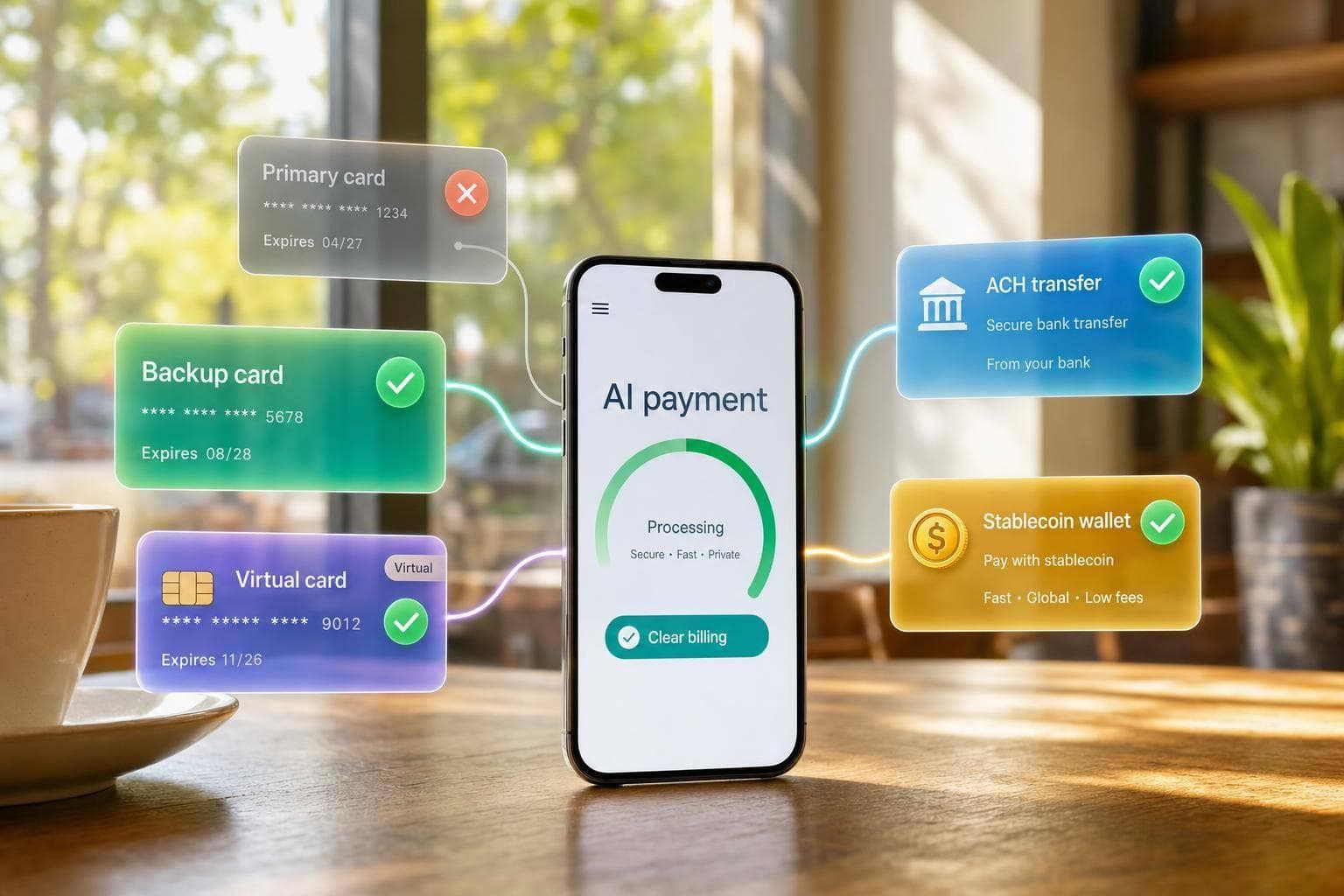
If your adult AI payment fails, the card often isn’t the main issue. In many cases, banks and card networks treat this category as high-risk, which can lead to checkout declines, failed renewals, or card options disappearing. My takeaway is simple: don’t rely on one payment method.
Here’s the short version:
- I’d keep at least one backup card
- I’d use virtual or prepaid cards for more privacy
- I’d look for wallet, ACH, or stablecoin options when card payments fail
- I’d prefer prepaid credits or token packs over auto-renewals when possible
- I’d check billing descriptors, receipts, and cancellation terms before paying
- If a charge fails, I’d retry once, then switch methods
A few facts stand out:
- Adult merchants often face more payment scrutiny than standard online sellers
- ACH can offer more stable billing because it skips card networks
- USDC and USDT can reduce card-network declines, but payments are final
- Many disputes come from confusing descriptors or surprise renewals, not just fraud
Payment Processors Keep BANNING Content...
sbb-itb-97c8eab
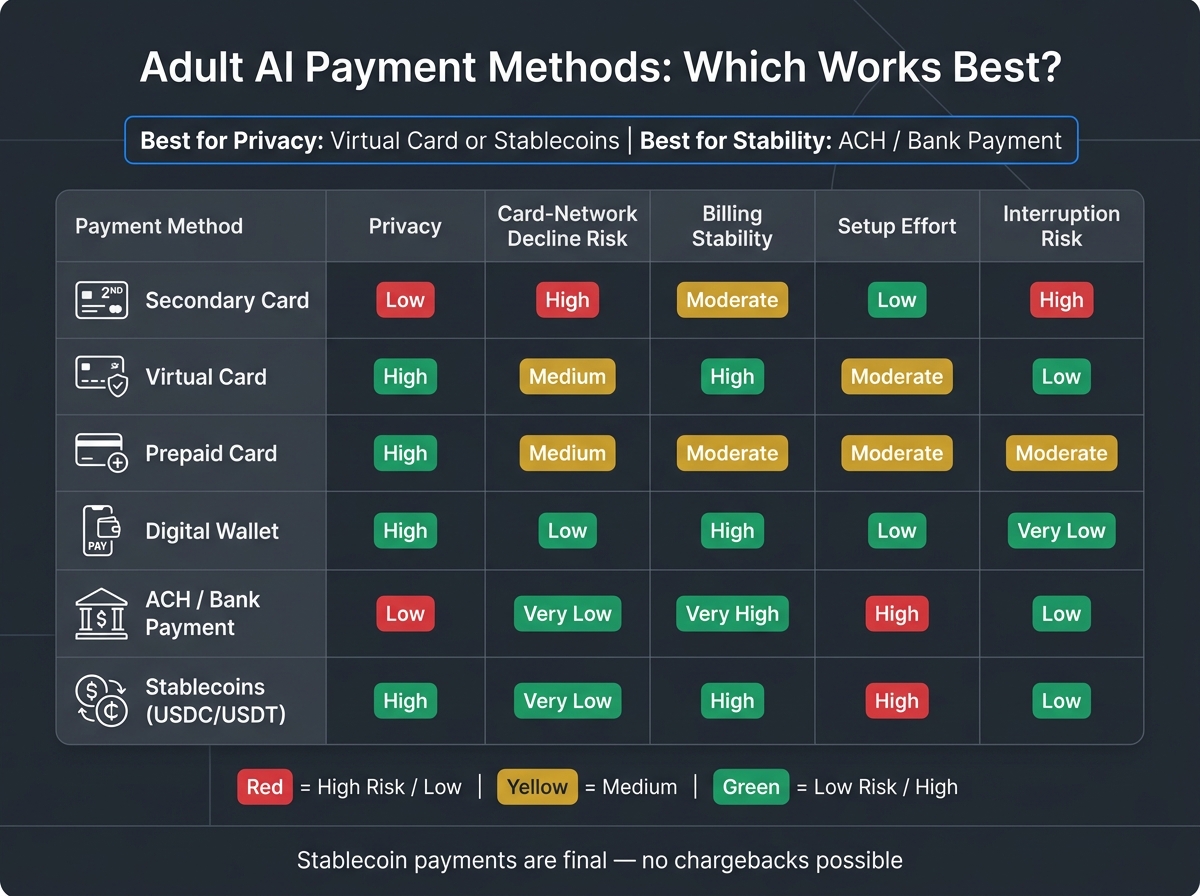
Quick Comparison
Adult AI Payment Methods Compared: Privacy, Stability & Decline Risk
| Option | Privacy | Chance of Card-Network Decline | Billing Stability | Main Tradeoff |
|---|---|---|---|---|
| Secondary card | Low | High | Medium | Still tied to card rules |
| Virtual card | High | Medium | High | Setup takes a bit more work |
| Prepaid card | High | Medium | Medium | Load fees and mixed acceptance |
| Digital wallet | High | Low | High | Platform support varies |
| ACH / bank payment | Low | Very low | Very high | You share bank details |
| Stablecoins | High | Very low | High | Final payments, wrong-chain risk |
Bottom line: I’d treat payment backup as a must, not an afterthought. A mix of card fallback, non-card rails, and clear billing terms is usually the best way to cut failed payments and avoid account access issues.
Backup Payment Paths When Cards Fail
When a card gets declined, a backup payment path can keep access from getting cut off. That matters more than most people think. One failed charge shouldn't shut everything down.
Secondary Cards, Virtual Cards, and Prepaid Options
A second card is the simplest fallback when your first card is declined. It doesn't take much setup, and it's often the fastest fix.
Virtual cards add another layer of separation. They can help keep adult spending apart from your main account, which many people prefer for privacy and cleaner account history.
A prepaid card paired with a dedicated email can further reduce the link between adult spending and your main identity. It’s not foolproof. Prepaid cards can still fail. But they do stop one declined card from ending access right away.
Digital Wallets and Bank-Based Payment Options
Digital wallets and ACH payments can get around card-network declines. That’s the big draw.
For U.S. users, ACH transfers offer very high billing stability because they bypass card networks entirely. The tradeoff is simple: you have to share bank account details, which means less privacy. That balance is easier to spot in the table below.
Backup Payment Methods Compared
| Payment Method | Setup Effort | Privacy | Billing Stability | Fees | Interruption Risk |
|---|---|---|---|---|---|
| Secondary Card | Low | Low | Moderate | Standard | High |
| Virtual Card | Moderate | High | High | Low/Variable | Low |
| Prepaid Card | Moderate | High | Moderate | Load fees | Moderate |
| Digital Wallets | Low | High | High | Platform fees | Very Low |
| ACH/Bank-Based | High | Low | Very High | Low | Low |
How AI Mistress Reduces Checkout Friction
Some platforms lower decline risk before checkout even begins. AI Mistress cuts payment friction with anonymous-by-design access, no real-name signup, and a freemium path that lets users try before paying.
Blockchain Rails and Stablecoins as a Payment Fix
When cards keep failing, stablecoins give platforms a non-card fallback. They skip card-network screening, so declines tied to adult merchants are less likely.
Why Crypto Payments Avoid Many Card-Network Blocks
Card declines on adult platforms often happen because the usual card approval path flags adult merchant category codes. Blockchain transfers skip that path. The payment moves wallet-to-wallet, with no card network in the middle to stop it.
Stablecoins like USDC and USDT keep pricing close to the subscription amount. Privacy is another clear plus: stablecoin payments don’t show up as card-statement line items.
That makes stablecoins a backup rail, not a replacement for cards.
Offering Crypto as a Fallback, Not the Only Option
Most U.S. users still reach for a card first. So the better setup is simple: keep cards as the default, then add stablecoin payments as a clearly labeled fallback.
If you offer crypto, show the USD price and the stablecoin amount side by side. Spell out the exact amount to send, the correct wallet address, and the expected confirmation time in plain English before the user commits.
What Users Need to Know Before Paying with Stablecoins
With stablecoins, the main risk shifts from approval to sending the payment the right way.
Before sending USDC or USDT, users need to confirm the accepted network and wallet address. Send a transfer on the wrong chain, and it can’t be recovered. On top of that, stablecoin payments are final.
Cards vs. Stablecoin Payments: A Direct Comparison
| Feature | Card Payments | Stablecoin Payments |
|---|---|---|
| Approval Risk | High - frequent blocks for adult merchant codes | Low - wallet-to-wallet, no card network involved |
| Privacy | Low - transactions appear on bank statements | High - pseudonymous, no identifiable bank trail |
| Speed | Instant at checkout | Near-instant to a few minutes, depending on network traffic |
| Reversibility | Yes - chargebacks and disputes are possible | No - transactions are final and irreversible |
| Ease of Use | High - standard checkout flow for U.S. users | Moderate - requires wallet setup and network knowledge |
| Fees | Standard card processing fees | Network "gas" fees, which vary by chain |
| Dispute Handling | Bank-mediated | No chargebacks; disputes must be resolved directly with the platform |
That tradeoff is why billing controls matter next.
Token Billing, Fraud Checks, and Chargeback Control
Once payment rails are fixed, billing design often becomes the next place where declines and disputes show up.
Why Token or Credit Packages Cut Billing Friction
Token and credit packages lower friction because they replace auto-renewals with prepaid balances. They also separate chat costs from image and video costs, so users can see what they’re paying for before they unlock content.
This model also fits media-heavy usage better than a flat monthly fee. People can spend credits at their own pace, which often feels easier to control than a subscription that keeps renewing in the background.
A simple way to handle this: let users begin with a small credit pack, then move to higher-value purchases once they know the service.
Fraud Controls That Lower False Declines and Chargebacks
Fraud controls need to stop abuse without slowing checkout. That balance matters. If checks are too loose, risk goes up. If they’re too strict, good users get blocked.
Mandatory 18+ verification and adult-friendly processors help lower risk.
Clear Descriptors, Receipts, and Cancellation Flows
A lot of chargebacks come from friendly fraud. A user sees an explicit statement descriptor, feels embarrassed, and disputes the charge instead of contacting support. A neutral or discreet billing descriptor can help cut that risk.
It also helps to send itemized receipts and renewal emails that repeat the billing name, amount, and renewal date. That way, there’s less room for confusion later.
Cancellation terms should be easy to find too, including any notice period before renewal, such as seven days, to help prevent renewal disputes. When users know exactly how recurring billing works and how to stop it, they’re less likely to go straight to their bank.
If a charge still fails, the next step is a simple recovery path.
How to Pay More Safely and Reliably: User Guide and Takeaways
What to Do After a Payment Decline
Even with billing controls in place, users still need a fast way to recover when a charge fails.
If your payment is declined, don’t keep hammering the retry button. Repeated attempts can trigger extra fraud flags from the card network or your bank, which can make the payment even harder to complete after the original issue is fixed.
A better path is simple:
- Check your bank’s SMS or email alerts to see whether the bank flagged the charge
- Retry only once
- If it still fails, switch to a virtual card or prepaid card
If the platform accepts stablecoins and you’re comfortable using a crypto wallet, that route can skip card-network limits altogether.
How Platforms Should Explain Privacy and Billing
To cut down on repeat declines and billing disputes, payment details need to show up before the user pays.
Users should see statement details right at checkout. That means the payment screen should show the billing descriptor, refund policy, and cancellation terms. The checkout flow should also make the statement descriptor, cancellation steps, and data-retention policy easy to spot.
Why does that matter? Because people get nervous when billing feels vague. Encrypted checkout and a clear data-retention policy can make the payment process feel safer.
Key Takeaways
Banks and card networks treat adult AI as high-risk, so stricter filters apply to more transactions.
| Problem | Fix |
|---|---|
| Card blocked at checkout | Verify bank alerts, retry once, then switch to a virtual or prepaid card |
| Privacy concerns on statements | Use a prepaid card and dedicated email; check the platform's billing descriptor |
| Persistent card-network blocks | Use stablecoin or crypto payment if available |
| Unexpected charges or renewals | Review cancellation and refund terms before subscribing |
| Chargeback risk | Use discreet descriptors and clear refund rules |
Using a card backup, a non-card payment rail, and clear billing terms can help reduce failed payments.
FAQs
Why do adult AI card payments get blocked?
Adult AI card payments often get blocked because adult content and NSFW charges can trip payment processor, bank, or fraud-screening systems. That happens a lot with some international cards.
Some platforms work with processors that are set up to handle adult-compliant payments. Even then, if your bank flags the charge, you might see a block or even a temporary lockout.
A few common fixes can help:
- Complete any required age verification
- Let your bank know before you subscribe
- Use the platform’s supported payment method
Which backup payment method is best for privacy?
For privacy, a prepaid card paired with a dedicated email address is the best backup payment method.
Why this setup? It helps limit the personal information you share with the platform and adds a bit more discretion if you run into payment blocks.
Also, check that your chosen payment method meets the platform’s processing requirements.
Are stablecoin payments safe to use?
Yes - stablecoin payments can be a safe option when card processors flag or block adult transactions. They can offer more private, discreet payments and help you keep access when standard gateways stop working.
For added safety, check that the platform uses secure, encrypted payment tokens and that your wallet provider has a solid reputation.